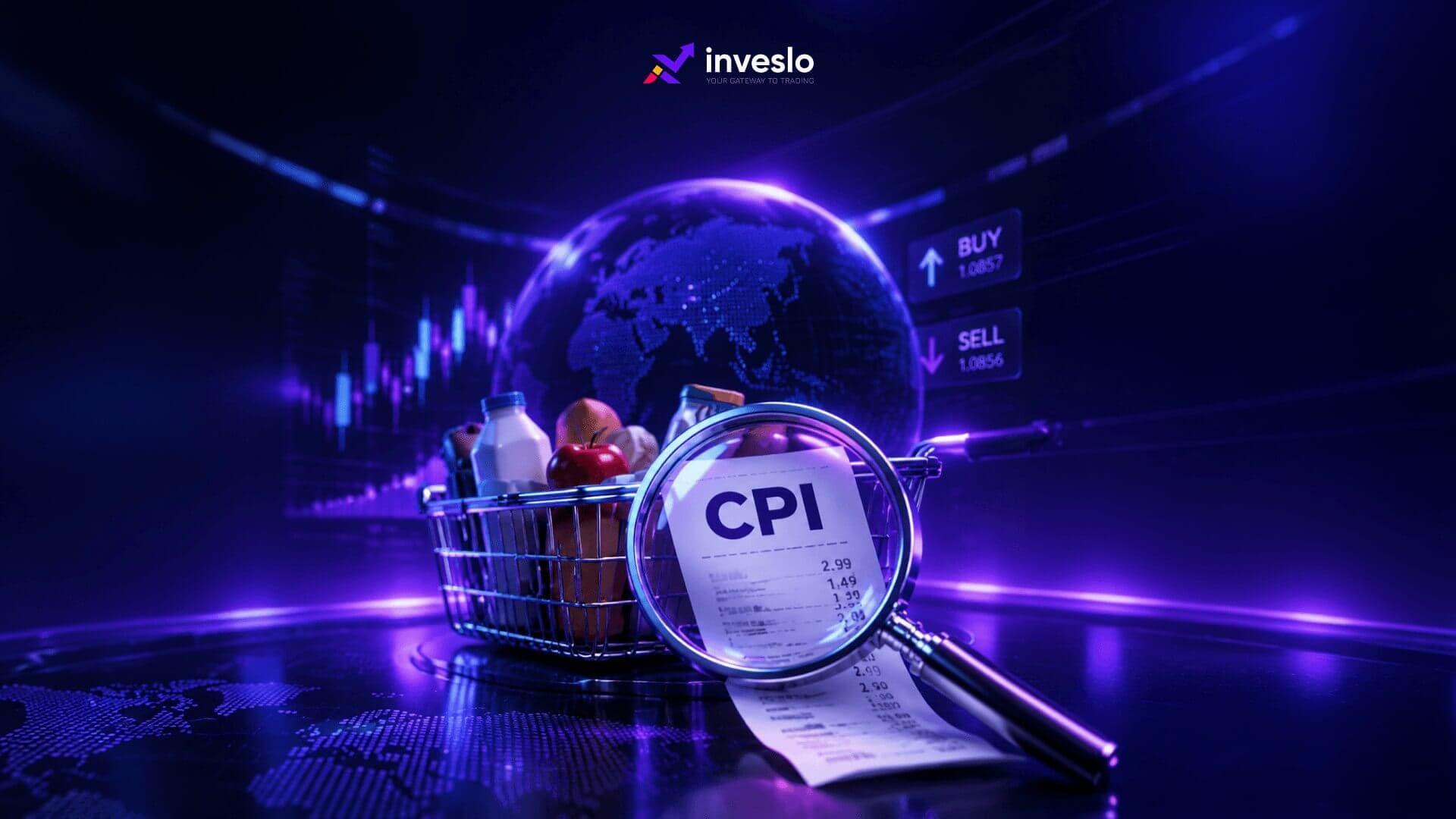
The Consumer Price Index (CPI) tracks the average change over time in prices consumers pay for a representative basket of goods and services. It is one of the main measures used to monitor consumer inflation. In the United States, the Bureau of Labor Statistics (BLS) produces CPI data and publishes it regularly.
A CPI release can move currencies, gold, stock indices, and bond yields within minutes. Yet the headline number alone rarely explains what traders actually need to know.
Was inflation higher or lower than expected? Did core inflation tell a different story? Was the monthly trend accelerating even though the annual rate fell? Most importantly, could the data change expectations for interest rates?
Understanding these questions starts with knowing what CPI actually measures.
For traders, CPI matters because inflation can affect central bank policy expectations. Those expectations can influence currencies, bonds, equities, precious metals, and other traded markets.
What Does CPI Measure?
CPI measures how the prices paid by consumers change over time.
Think of it as a large representative shopping basket. Instead of tracking the price of one product, statistical agencies monitor many goods and services that households regularly purchase.
In the U.S., the BLS groups CPI expenditure into eight broad categories:
- Food and beverages
- Housing
- Apparel
- Transportation
- Medical care
- Recreation
- Education and communication
- Other goods and services
The basket also includes certain taxes directly connected with purchases, such as sales and excise taxes. Investments such as stocks and bonds, however, are outside the CPI because they are not treated as consumer expenditure.
CPI therefore answers a specific question: How have consumer prices changed compared with an earlier period?
It does not tell you exactly how much every individual household's cost of living has changed.
How is the Consumer Price Index Calculated?
The basic idea is straightforward: compare the cost of a representative group of consumer purchases over time.
A simplified representation is:
CPI = (Cost of the basket in the current period ÷ Cost of the basket in the base period) × 100
Actual CPI calculation is considerably more detailed.
The BLS collects expenditure information to determine what consumers buy and how much weight different categories should receive. It then gathers price information from selected locations, businesses, service providers, rental units, and other sources.
Items consumers spend more money on generally have greater influence on the overall index than categories representing a smaller share of expenditure.
This weighting matters. A sharp change in a heavily weighted category can have a much larger effect on CPI than an equally large price movement in a smaller category.
CPI vs. Inflation: Are They the Same Thing?
Not exactly.
CPI is an index used to measure changes in consumer prices. Inflation is the rate at which the general price level increases.
People often use "CPI" and "inflation" interchangeably because percentage changes in CPI provide a widely followed measure of consumer inflation.
For example, traders may hear that "CPI rose 3% year over year." That usually means the CPI level was 3% higher than it was during the comparable period one year earlier.
A rising CPI generally indicates increasing consumer prices. A slower CPI growth rate means inflation is cooling, but prices are not necessarily falling.
That distinction is easy to miss.
If annual CPI moves from 5% to 3%, consumer prices are still rising overall. They are simply increasing at a slower annual rate.
Headline CPI vs. Core CPI
Economic calendars often show both headline CPI and core CPI.
|
Measure |
What it includes |
What traders learn from it |
|
Headline CPI |
The full CPI basket |
Broad consumer price movement |
|
Core CPI |
Excludes food and energy |
A view of underlying price trends without two volatile categories |
The BLS confirms that food and energy remain part of the headline CPI. The separate index excluding food and energy is commonly called core CPI.
Core CPI can help analysts examine whether price pressure extends beyond categories that can experience sudden swings.
Neither measure should automatically replace the other. A large energy-price increase can materially affect households and headline inflation even if core CPI remains relatively stable.
Month-over-Month vs. Year-over-Year CPI
Another common mistake is looking at one CPI percentage without checking its timeframe.
Month-over-month (MoM) CPI compares prices with the previous month.
Year-over-year (YoY) CPI compares prices with the same month one year earlier.
They answer different questions.
MoM data can provide a more immediate view of current price momentum. YoY data provides a broader picture, but it can change partly because an unusually high or low month from the previous year drops out of the comparison.
For traders, checking both can reveal information hidden by the headline annual figure.
A falling YoY inflation rate, for example, does not automatically mean current monthly inflation pressure has disappeared.
Why Does CPI Matter to Traders?
CPI matters because inflation is closely connected with monetary policy.
Central banks assess inflation alongside employment, economic growth, financial conditions, and other information when making policy decisions. A CPI result that changes expectations for future interest rates can therefore trigger repricing across several markets.
The critical point is that markets often react to the difference between the reported data and what participants expected, rather than simply whether CPI is high or low.
Suppose markets expect annual CPI of 3.0%.
If the CPI report comes in at 3.0%, much of that information may already be reflected in market prices. A result materially above or below expectations can create a larger adjustment because traders need to reassess their assumptions.
The reaction still depends on context. One CPI release does not determine monetary policy by itself.
How Can CPI Affect Forex, Gold and Indices?
There is no fixed rule saying a higher CPI must produce one particular market outcome.
Forex
Higher-than-expected inflation can cause traders to reassess the likely path of interest rates. If markets begin expecting tighter monetary policy or fewer rate cuts, the affected currency may strengthen.
But currency prices are relative. EUR/USD, for example, reflects expectations concerning both the euro and U.S. dollar. A U.S. CPI surprise cannot be interpreted in isolation from the outlook for the euro area.
Gold
Gold can react strongly around major U.S. inflation releases because CPI can change expectations for interest rates, bond yields, and the U.S. dollar.
The relationship is not mechanical. Gold may respond differently depending on real yields, risk sentiment, positioning, and what markets had already priced in.
Stock Indices
Equity markets may interpret inflation through its possible effect on interest rates, financing conditions, company costs, and future earnings.
The same CPI result can affect sectors differently. That is one reason "CPI rose, so stocks should fall" is too simplistic for a trading decision.
For traders monitoring CPI-driven market movements, having access to multiple asset classes can help them analyze how inflation data affects different markets. Inveslo provides access to forex, spot metals, spot energies, cryptocurrencies, and CFD indices through MT4 and MT5 accounts, allowing traders to follow these market reactions from one platform.
Why Does the Market Sometimes Move the "Wrong" Way After CPI?
Because traders are reacting to more than the headline number.
Consider a report where headline CPI is above expectations but core inflation is weaker. The initial reaction could reflect the headline surprise, followed by a reversal once traders examine the details.
Other factors can interfere too:
- Expectations may already be heavily priced in.
- Monthly and annual CPI may send different signals.
- Individual CPI components may change the interpretation.
- Another economic release may arrive at the same time.
- Traders may focus on what the report means for the next central bank decision rather than the CPI figure itself.
For this reason, treating "high CPI = buy" or "low CPI = sell" as a trading rule ignores how markets process economic information.
What Should Traders Check Before a CPI Release?
Instead of focusing on one number, compare four pieces of information:
- Previous CPI: What did the last report show?
- Market forecast: What result is currently expected?
- Actual CPI: How far did the released number differ from expectations?
- Core and monthly readings: Do the underlying figures support or contradict the headline result?
Then consider the policy backdrop.
Is the relevant central bank concerned about persistent inflation? Are markets expecting rate cuts or rate increases? Has the currency already moved sharply before the release?
Those questions often provide more context than the CPI number alone.
CPI releases can also produce rapid price changes and wider spreads. Inveslo states that its spreads are floating and may increase during particular periods depending on market conditions. Traders should account for changing execution conditions around major economic announcements.
What a CPI Report Cannot Tell You?
CPI is useful, but it has limits.
First, it represents average price changes for a defined population and expenditure basket. Your personal inflation rate may differ because your spending pattern is different.
Second, CPI is backward-looking. It reports price changes that have already occurred.
Third, changes in consumer behaviour complicate inflation measurement. Consumers may switch between products when relative prices change. The BLS uses statistical methods to account for some substitution within categories, while its Chained CPI measure is designed to reflect substitution across categories more broadly.
Finally, CPI is one piece of economic information. Central banks and market participants also monitor employment, wages, economic activity, producer prices, consumption data, and other inflation measures.
Common CPI Mistakes Traders Should Avoid
A common error is trading solely because CPI is "high" or "low." Markets care about expectations and future policy implications.
Another is confusing lower inflation with falling prices. Inflation can slow while the overall price level continues to increase.
Ignoring core CPI can also leave part of the story unexplained, while focusing exclusively on core CPI can hide meaningful food or energy price pressure.
The bigger mistake is assuming every CPI surprise produces the same reaction. Market positioning, central bank expectations, and the details inside the CPI report can all change the outcome.
Reading CPI as a Trader
CPI becomes more useful when you stop treating it as a standalone number.
Check the actual result against expectations. Compare headline and core inflation. Look at monthly momentum, then consider what those figures could mean for central bank expectations.
That approach will not predict every market reaction. It does give you a clearer framework for understanding why currencies, metals, and indices can move sharply around inflation data.
If you trade markets affected by major economic releases, you can explore the instruments and MT4/MT5 account options available through Inveslo and assess whether they fit your trading approach.
Frequently Asked Questions About CPI
What does CPI stand for?
CPI stands for Consumer Price Index, an index that tracks average changes in consumer prices over time.
Is a high CPI good or bad?
There is no universal answer. Rapid inflation can reduce purchasing power and affect monetary policy, but traders need to compare the CPI result with forecasts, previous data, and the wider economic environment.
What is core CPI?
Core CPI commonly refers to CPI excluding food and energy. Analysts follow it because those categories can experience large short-term price movements.
Why is CPI important for forex trading?
CPI can change expectations about interest rates. Changes in expected rate paths can affect demand for currencies and create volatility in forex pairs.
Can CPI affect gold prices?
Yes. CPI can influence expectations for U.S. monetary policy, interest rates, yields, and the dollar, all of which can affect gold. The direction is not guaranteed from the CPI figure alone.
Related articles
 ForexInveslo
What is a Trading Journal & How Do Traders Use It?
A trader can remember a big winner for months and forget three poorly planned trades from the same week. That is one reason relying on memory makes trade review difficult.
 ForexInveslo
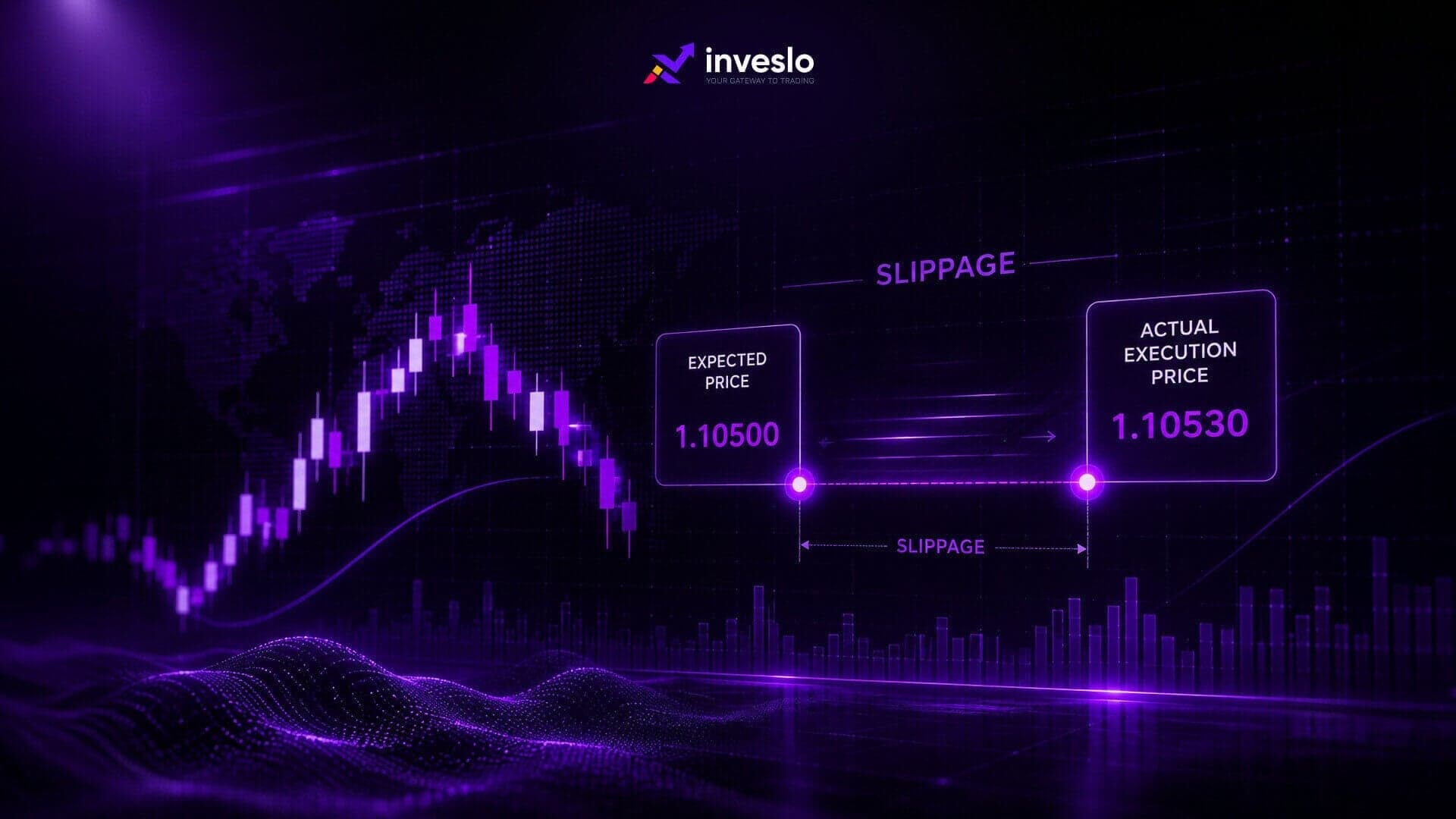
Slippage in Trading: What it is and How to Reduce it?
Slippage in trading costs most retail traders more than they realise, and it's rarely discussed until after the damage is done. You place an order at one price, it fills at another, and suddenly your trade is already underwater before the market's moved a tick against you. It happens fast.
 ForexInveslo
What is NFP (Non-Farm Payrolls) and How it Moves the Forex Market?
NFP forex trading turns the first Friday of every month into something most traders dread and anticipate in equal measure. No other scheduled data release moves currency pairs this fast, this far, or this unpredictably.