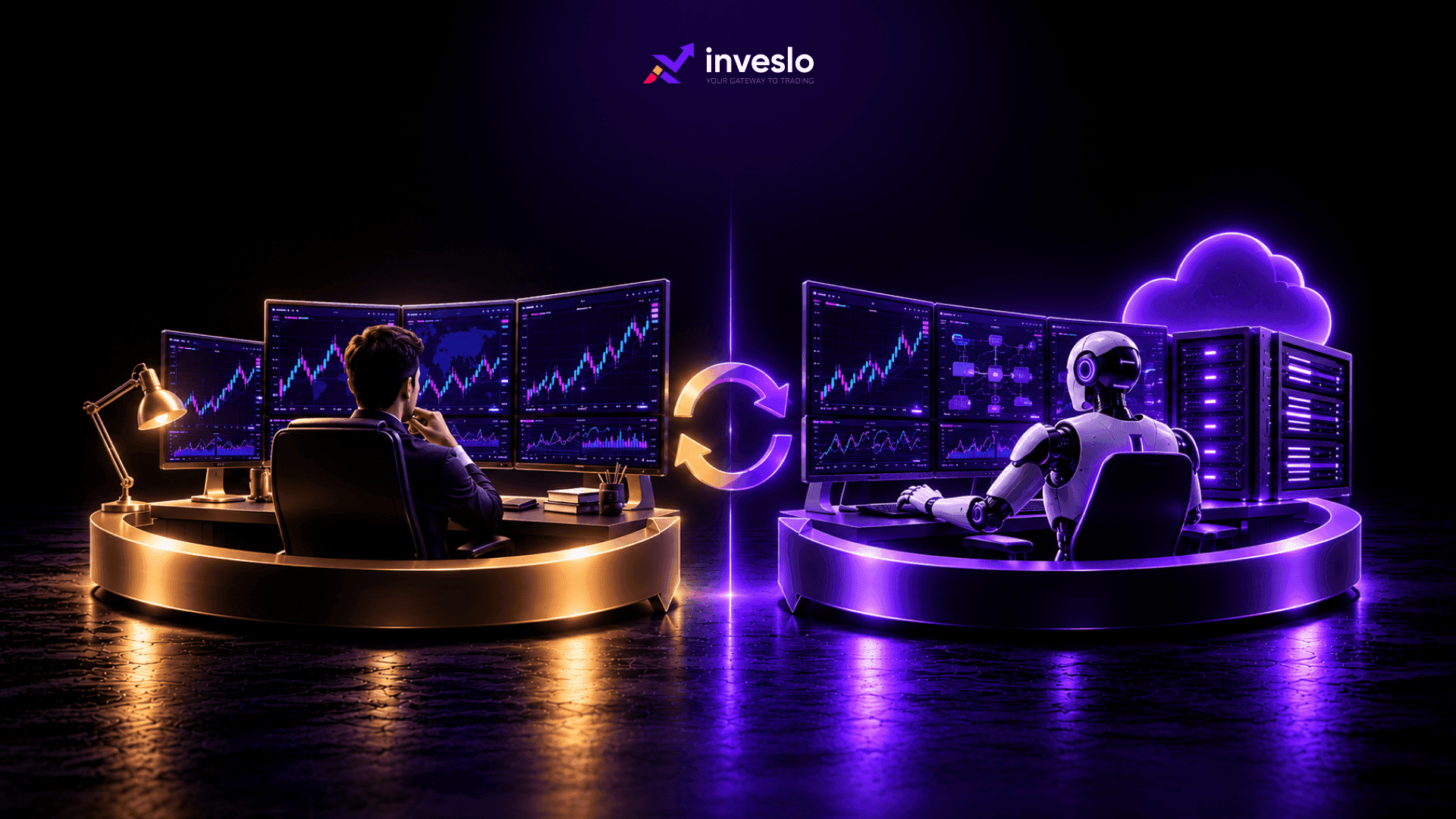
A trader can have a solid strategy and still struggle with one basic decision: should every trade be placed manually, or should software handle the process?
Manual trading gives you direct control over analysis, entries, exits, and trade management. Automated trading uses predefined rules to monitor markets and execute actions through software such as Expert Advisors, or EAs.
Neither approach is automatically better. Manual trading suits strategies that depend heavily on judgment and changing market context. Automated trading suits strategies that can be expressed as clear rules and repeated consistently. For many traders, the better answer is a mix of both.
What is Manual Trading?
Manual trading means the trader makes each trading decision personally.
You review charts, follow market conditions, decide whether a setup meets your rules, choose the position size, place the order, and manage the trade yourself.
A manual forex trader might wait for EUR/USD to reach a support area, check price action and upcoming economic events, then decide whether the setup still makes sense before entering.
The trader remains responsible for every decision from entry to exit.
Where Manual Trading Works Well
Manual trading gives you room to respond to situations that are difficult to define in code.
You can avoid a setup because market conditions feel abnormal, reduce activity around major news, or skip a technically valid signal because the wider context has changed.
That flexibility can matter for discretionary strategies where the setup depends on interpretation rather than a fixed checklist.
Manual trading can also help newer traders understand how orders, spreads, volatility, stop-losses, and market sessions behave before they automate any part of the process.
What is Automated Trading?
Automated trading uses software to follow predefined trading rules.
A system can monitor prices, identify specific conditions, calculate an order size, open a position, place protective orders, and close the trade according to programmed instructions.
On MT4 and MT5, traders commonly use Expert Advisors for this purpose.
An automated system does not understand the market in the same way a person does. It follows the logic it has been given. If the rules say to buy when certain conditions occur, the system can act even if the trader is away from the screen.
Inveslo supports Expert Advisors on both MT4 and MT5, allowing traders to run automated strategies through those platforms.
Manual Trading vs Automated Trading: Main Differences
Factor | Manual Trading | Automated Trading |
Decision-making | Trader decides | Software follows predefined rules |
Execution | Orders placed manually | Orders can be placed automatically |
Speed | Depends on reaction time | Can react as soon as conditions match |
Market monitoring | Limited by trader availability | Can monitor continuously while running |
Emotion | Can affect decisions | Execution follows programmed logic |
Flexibility | High | Limited to programmed rules |
Testing | Harder with subjective setups | Easier with clearly defined rules |
Technical setup | Lower | Higher |
Best fit | Discretionary strategies | Rule-based strategies |
The real difference is where the decision happens.
With manual trading, the decision happens in real time through human judgment.
With automated trading, much of that decision-making is written into the system before the trade occurs.
Manual vs Automated Trading: Which Offers More Control?
Manual trading gives you more immediate control.
You can change your mind, ignore a signal, close early, reduce position size, or avoid trading entirely if conditions look unusual.
That freedom is useful, but it can also create inconsistency.
A trader might follow the plan closely on Monday, hesitate on Tuesday, move a stop on Wednesday, and take an impulsive trade on Thursday.
Automated trading works differently. Once the rules are set, the system can apply them repeatedly without hesitation.
That consistency can be useful, but it creates another risk: a bad rule can also be applied consistently.
Automation does not improve weak logic. It simply executes the instructions more reliably.
Which is Faster: Manual or Automated?
Automated trading is generally faster at reacting to predefined conditions.
If a strategy requires an order as soon as price reaches a certain level and several indicators agree, software can respond faster than a person who first needs to notice the setup and place the order.
That can matter for short-term strategies where timing is sensitive.
For a swing trader working from four-hour or daily charts, the speed difference may matter much less.
Execution speed should therefore match the strategy rather than being treated as a benefit on its own.
How Do Emotions Affect Each Approach?
Manual trading leaves more room for emotion to influence execution.
Fear can cause a trader to exit too early. Frustration can lead to another trade immediately after a loss. Confidence after several wins can encourage larger positions.
Automated systems can reduce those emotional changes during execution because the software follows set rules.
The emotional problem does not disappear completely.
A trader can still stop the system after a losing streak, increase its risk settings, keep changing parameters, or activate an untested strategy because recent results looked good.
Automation changes where emotional mistakes can happen. It does not remove them.
Can Automated Trading Run Without Supervision?
It can operate without constant manual input, but it still needs monitoring.
Automated systems depend on several things working correctly:
● The strategy logic
● Platform connectivity
● Market data
● Broker execution
● Position-size settings
● Stop and exit rules
A connection issue, incorrect parameter, symbol mismatch, or unexpected market condition can affect results.
For this reason, “automated” should not be interpreted as “set once and ignore.”
Which is Easier to Test?
Automated strategies are usually easier to test when every rule is clearly defined.
If entry, exit, position sizing, stop-loss, and trade filters are expressed as fixed conditions, those rules can be tested on historical data.
Manual strategies are harder to test because judgment may change from one setup to another.
For example, “buy when price breaks resistance” sounds simple until the trader adds conditions such as market tone, news risk, candle structure, or whether the breakout “looks clean.”
Those judgments are difficult to reproduce exactly across hundreds of historical examples.
Testing still has limits. Historical results do not guarantee future performance, and a system can be fitted too closely to past data.
What Traders Often Miss About Automated Trading
The biggest mistake is assuming that automation turns a strategy into a better strategy.
It does not.
A system with weak entry rules, poor risk controls, or unrealistic assumptions can simply lose money more consistently.
Another issue is changing market behaviour. A strategy that performs well in a steady trend may struggle during choppy conditions. If the code has no way to recognise that change, it may keep trading.
Technical maintenance matters too. Software updates, platform settings, broker specifications, and account conditions can affect how an EA behaves.
These are practical operating issues, not minor details.
What Traders Often Miss About Manual Trading
Manual trading is sometimes treated as the simpler option because it requires less technical setup.
That can be misleading.
The trader still needs a defined process for entries, exits, risk, review, and trade selection. Without clear rules, “manual” can become another word for inconsistent.
Fatigue also matters.
A trader who has watched charts for several hours may make different decisions from the same trader at the start of the session.
Manual trading works best when judgment is supported by structure.
Which is Better for Busy Traders?
Automated trading can suit traders who cannot watch markets continuously, provided the strategy can be expressed clearly in rules.
A system can monitor conditions while the trader is working or away from the platform.
That does not mean every busy trader should automate.
If the strategy depends heavily on reading news, unusual price behaviour, or discretionary context, full automation may produce poor decisions.
In that case, alerts or partial automation may make more sense.
Semi-Automated Trading: Using Manual and Automated Trading Together
Manual and automated trading do not have to be treated as opposite choices.
A trader can make the main decision manually while allowing software to handle repetitive parts of the process.
For example:
The trader identifies the setup manually.
Software calculates position size.
The order is placed with predefined stop and target rules.
The trader reviews the position only if conditions change.
Another approach is automated scanning with manual confirmation.
This can reduce repetitive work while keeping human judgment where it matters.
Which Approach Fits Different Trading Styles?
1. Scalping
Automated execution may suit scalping because timing can be very sensitive.
Manual scalping is still possible, but the trader must react quickly and maintain concentration.
2. Day Trading
Both approaches can work.
Manual day traders may prefer direct control around session activity and economic releases. Automated day traders can apply clearly defined intraday rules without constant clicking.
3. Swing Trading
Manual trading often fits swing strategies well because decisions happen less frequently.
Automation can still help with alerts, entry rules, stop management, or full execution if the strategy is systematic.
4. Multi-Market Trading
Monitoring several markets manually can become difficult.
Automation can watch multiple instruments at once, but each market still needs suitable rules and risk settings.
Best Trading Approach for Beginners: Manual or Automated?
Manual trading can be a useful starting point because it teaches the mechanics of placing orders, setting stops, managing trades, and reading market conditions.
Automating a strategy before understanding how it behaves can hide mistakes rather than solve them.
A beginner who later moves toward automation should be able to explain the strategy in plain language first.
If the rules cannot be described clearly, they will be difficult to code clearly.
Beginners can also use a demo account to practise these steps in a simulated environment before using live funds. It can also help them test whether a strategy is clear and consistent enough to automate later.
How to Choose Between Manual and Automated Trading?
Use these questions as a decision check.
Can your strategy be written as fixed rules?
If yes, automation may be suitable.
Does the setup depend on judgment or context?
Manual execution may fit better.
How much time can you spend monitoring markets?
Limited availability may make automation or alerts useful.
Do you frequently break your own rules?
Automation can make execution more consistent, but the underlying strategy still needs to be sound.
Can you test and maintain the system?
Automated trading needs regular checking rather than permanent hands-off use.
Manual or Automated Trading: Which is Better?
Neither approach wins in every situation.
Manual trading is better suited to traders who want direct control and use strategies that depend on interpretation.
Automated trading fits traders with clearly defined rules who want consistent execution and less dependence on constant screen time.
A mixed approach can work well when part of the process is repetitive but the final decision still benefits from human judgment.
Inveslo supports manual and automated trading through MT4 and MT5, including Expert Advisors and demo access for testing platform features before using live funds.
If you are deciding between the two, test the workflow first and compare how well each approach follows your actual trading rules rather than choosing based on speed or convenience alone.
FAQs
Q1. What is manual trading?
A. Manual trading means the trader personally analyses the market, places orders, manages positions, and decides when to exit.
Q2. What is automated trading?
A. Automated trading uses software to monitor markets and execute predefined trading rules without requiring the trader to place every order manually.
Q3. Is automated trading more profitable than manual trading?
A. No method guarantees higher profits. Results depend on the strategy, risk controls, execution conditions, and how well the approach fits the market.
Q4. Can manual and automated trading be combined?
A. Yes. Traders can automate scanning, sizing, entries, or trade management while keeping part of the decision process manual.
Q5. Is automated trading suitable for beginners?
A. It can be used by beginners, but learning basic market mechanics and risk management first makes it easier to understand what the system is doing and where problems may occur.
Related articles
 ForexInveslo
Day Trading vs Swing Trading: Key Differences and How to Choose
Choosing between day trading and swing trading is less about finding the “better” strategy and more about finding the one you can execute consistently. Day trading keeps positions inside the same trading day and usually demands more screen time, faster decisions, and closer attention to short-term
 ForexInveslo
Forex Pairs Explained: Major, Minor & Exotic Currency Pairs
Opening a forex platform can leave you looking at dozens of symbols that seem similar but behave very differently. EUR/USD, EUR/GBP and USD/ZAR are all currency pairs, yet the cost of trading them, the amount of liquidity available and the events that move them can vary considerably
 ForexInveslo
What is RSI Indicator? Overbought, Oversold, and How to Trade It
A price chart can show you where a market is moving, but it does not always make the strength of that move easy to judge. A market can continue rising while momentum starts to weaken..