


Pound Sterling recovers against US Dollar despite hopes on US-China trade deal
- The Pound Sterling rebounds to near 1.3300 against the US Dollar as the USD Index struggles to extend its two-day recovery.
- US Treasury Secretary Bessent hopes for a reduction in additional tariffs by both the US and China on each other.
- Investors await the UK Retail Sales data for March.
The Pound Sterling (GBP) holds initial gains near 1.3300 against the US Dollar (USD) in Thursday’s North American session. The GBP/USD pair rebounds after a two-day correction as the USD struggles to extend the recovery, with the US Dollar Index (DXY), which tracks the Greenback’s value against six major currencies, facing pressure near the psychological level of 100.00.
The USD Index recovered strongly earlier this week after United States (US) President Donald Trump backed away from threats of sacking Federal Reserve (Fed) Chair Jerome Powell and softened his stance on trade relations with China.
President Trump clarified on Tuesday that he has no intention to fire Jerome Powell. Investors had dumped the US Dollar and US assets in the last few trading days due to a series of verbal attacks from Trump on the Fed’s independence for not backing monetary policy expansion. This led investors to reassess the “safe-haven” status of the US Dollar.
Meanwhile, diminishing fears of an intense trade war between the US and China had also boosted the USD’s demand. On Tuesday, Donald Trump signaled that “discussions with Beijing are going well” and expressed confidence that “they will reach a deal”.
Hopes of a de-escalation in the US-China relationship got an extra boost as US Treasury Secretary Scott Bessent indicated on Wednesday that both nations will reduce additional tariffs imposed lately. Neither side believes that these are “sustainable levels,” Bessent said.
On the economic front, the US Durable Goods Orders data for March has come in stronger than expected. The cost of orders received by manufacturers for durable goods rose at a robust pace of 9.2% compared to estimates of 2% and a 0.9% increase seen in February. The impact of an increase in operational costs is expected to limit Fed's capaicity of reducing interesta rates.
During North American trading hours, Cleveland Fed Bank President Beth Hammack advised that the central needs to be "patient" before making adjustments in "monetary policy".
Daily digest market movers: Pound Sterling drops as BoE Bailey warns of trade war risk
- The Pound Sterling drops against its peers, except North American currencies, on Thursday. The British currency faces pressure as investors turn cautious over the likely United Kingdom's (UK) economic outlook in the face of tariffs announced by United States (US) President Donald Trump earlier this month.
- Bank of England (BoE) Governor Andrew Bailey has expressed concerns over economic growth and stressed the need to consider trade war risk. "We do have to take very seriously the risk to growth,” Bailey said at the sidelines of the International Monetary Fund’s (IMF) spring meetings on Wednesday and added, "We’re currently working through that because we’ve got an interest rate decision coming in two weeks’ time,” Reuters report. In the May policy meeting, traders are increasingly confident that the BoE will cut interest rates by 25 basis points (bps) to 4.25%.
- For the remaining year, the IMF has anticipated three interest rate cuts by the BoE and has revised UK Gross Domestic Product (GDP) growth for 2025 to 1.1% from 1.6% projected earlier amid worries of global fallout due to Trump’s international policies, BBC News reported.
- On the economic front, investors will focus on the United Kingdom (UK) Retail Sales data for March, which will be released on Friday. The Retail Sales data, a key measure of consumer spending, is expected to have declined by 0.4% month-on-month after rising by 1% in February. Over the year, the consumer spending measure is estimated to have risen at a moderate pace of 1.8% compared to the prior release of 2.2%.
British Pound PRICE Today
The table below shows the percentage change of British Pound (GBP) against listed major currencies today. British Pound was the strongest against the US Dollar.
| USD | EUR | GBP | JPY | CAD | AUD | NZD | CHF | |
|---|---|---|---|---|---|---|---|---|
| USD | -0.59% | -0.52% | -0.71% | -0.16% | -0.60% | -0.70% | -0.58% | |
| EUR | 0.59% | 0.08% | -0.13% | 0.43% | -0.02% | -0.11% | 0.01% | |
| GBP | 0.52% | -0.08% | -0.17% | 0.35% | -0.08% | -0.19% | -0.07% | |
| JPY | 0.71% | 0.13% | 0.17% | 0.52% | 0.10% | -0.04% | 0.15% | |
| CAD | 0.16% | -0.43% | -0.35% | -0.52% | -0.41% | -0.54% | -0.42% | |
| AUD | 0.60% | 0.02% | 0.08% | -0.10% | 0.41% | -0.10% | 0.02% | |
| NZD | 0.70% | 0.11% | 0.19% | 0.04% | 0.54% | 0.10% | 0.11% | |
| CHF | 0.58% | -0.01% | 0.07% | -0.15% | 0.42% | -0.02% | -0.11% |
The heat map shows percentage changes of major currencies against each other. The base currency is picked from the left column, while the quote currency is picked from the top row. For example, if you pick the British Pound from the left column and move along the horizontal line to the US Dollar, the percentage change displayed in the box will represent GBP (base)/USD (quote).
Technical Analysis: Pound Sterling recovers to near 1.3300
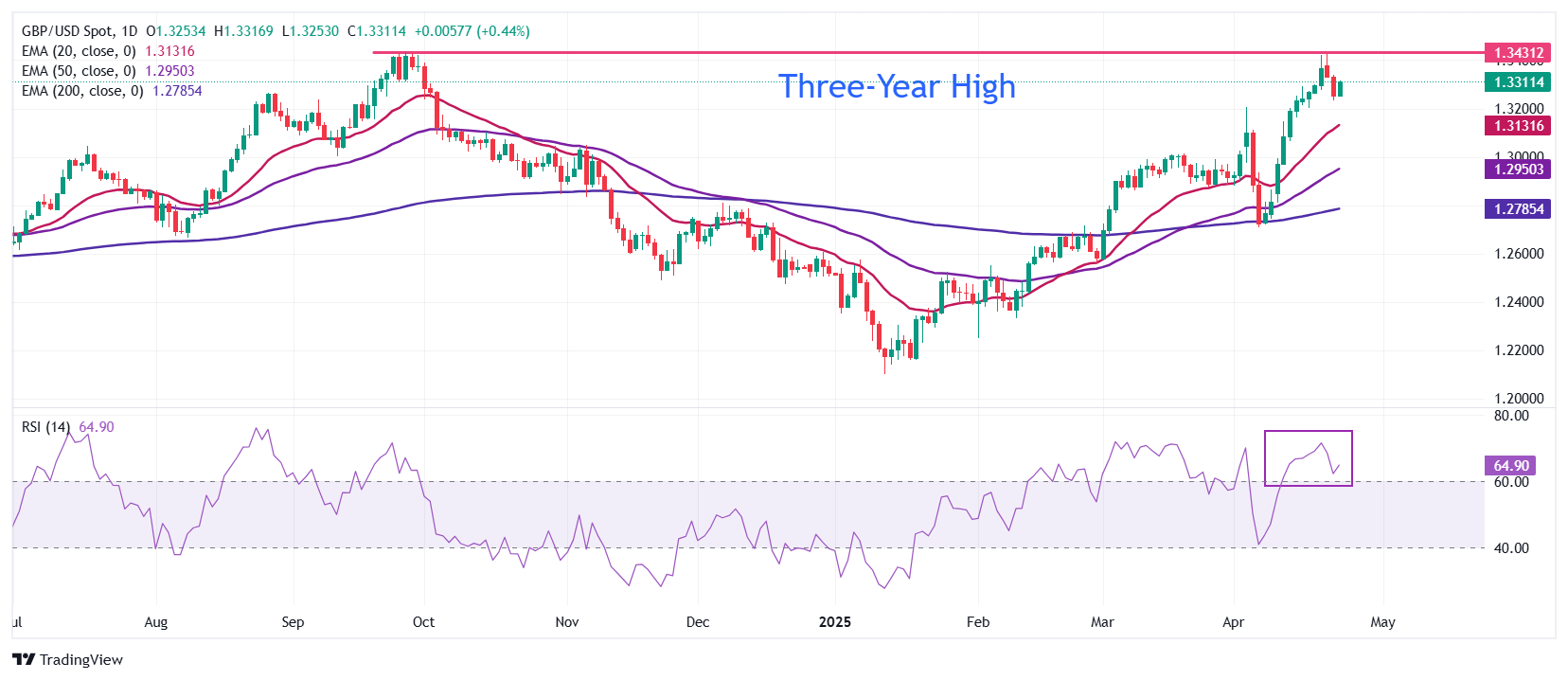
The Pound Sterling recovers to near 1.3300 against the US Dollar during European trading hours on Wednesday. The outlook of the pair remains firm as all short-to-long Exponential Moving Averages (EMAs) are sloping higher.
The 14-day Relative Strength Index (RSI) cools down to near 65.00 after turning overbought. This indicates a mild correction in the pair after a strong rally, but the upside trend is intact.
On the upside, the psychological level of 1.3500 will be a key hurdle for the pair. Looking down, the April 3 high around 1.3200 will act as a major support area.
US-China Trade War FAQs
Generally speaking, a trade war is an economic conflict between two or more countries due to extreme protectionism on one end. It implies the creation of trade barriers, such as tariffs, which result in counter-barriers, escalating import costs, and hence the cost of living.
An economic conflict between the United States (US) and China began early in 2018, when President Donald Trump set trade barriers on China, claiming unfair commercial practices and intellectual property theft from the Asian giant. China took retaliatory action, imposing tariffs on multiple US goods, such as automobiles and soybeans. Tensions escalated until the two countries signed the US-China Phase One trade deal in January 2020. The agreement required structural reforms and other changes to China’s economic and trade regime and pretended to restore stability and trust between the two nations. However, the Coronavirus pandemic took the focus out of the conflict. Yet, it is worth mentioning that President Joe Biden, who took office after Trump, kept tariffs in place and even added some additional levies.
The return of Donald Trump to the White House as the 47th US President has sparked a fresh wave of tensions between the two countries. During the 2024 election campaign, Trump pledged to impose 60% tariffs on China once he returned to office, which he did on January 20, 2025. With Trump back, the US-China trade war is meant to resume where it was left, with tit-for-tat policies affecting the global economic landscape amid disruptions in global supply chains, resulting in a reduction in spending, particularly investment, and directly feeding into the Consumer Price Index inflation.
Forex News
Keep up with the financial markets, know what's happening and what is affecting the markets with our latest market updates. Analyze market movers, trends and build your trading strategies accordingly.