


EUR/USD flirts with fresh six-month high after soft CPI release
- EUR/USD enters above 1.1100 after a volatile US close on Wednesday with Trump issuing tariffs pause.
- Markets see March US CPI data release come in softer than expected.
- The EUR/USD rally is still intact and re-enters the 1.1000-1.1500 region.
The EUR/USD pair sprints higher to 1.1133 at the time of writing on Thursday after the Consumer Price Index (CPI) release. A whipsaw session on Wednesday saw EUR/USD ranging from 1.1095 all the way down to 1.0913 as United States (US) President Donald Trump eased off his tariffs stance and lowered the reciprocal tariff rate for all countries to 10% during a 90-day pause.
The move came after several people, such as Elon Musk, Bill Ackman and some leading republican party figures – US Stock markets were also giving signs of warning – advised the US president that the reciprocal levies approach was hitting nerves. The 90-day pause was applauded by markets as US Equities went through the roof. The US Consumer Price Index (CPI) for March came in softer than expected and triggered another leg higher in EUR/USD price action.
Daily digest market movers: Opposite from expected
- March US CPI data:
-
-
- Headline monthly inflation contracted by 0.1%, against the expected uptick by 0.1%, compared to 0.2% in February. The yearly headline inflation fell to 2.4%, below the expected 2.6% in March, coming from 2.8%.
- Core monthly inflation fell to 0.1%, below the 0.3% survey number, coming from 0.2%. The yearly core inflation eased to 2.8%, below the 3.0% expected in March from 3.1% the previous month.
- Weekly US Jobless Claims will be released as well, with the initial claims coming in at 223,000 as expected, coming from 219,000. The Continuing Claims should fell to 1.85million, below the estimate of 1.88 million and from 1.903 million last week.
-
- At 13:30 GMT, Federal Reserve (Fed) Bank of Dallas President Lorie Logan is due to speak.
- At 14:00 GMT, Fed Governor Michelle Bowman gives a testimony at the Nomination Hearing Before the U.S. Senate Committee on Banking, Housing and Urban Affairs.
- At 16:00 GMT, Federal Reserve Bank of Chicago President and CEO Austan Goolsbee speaks at the Economic Club of New York.
- At 16:30 GMT, Philadelphia Fed bank President Patrick Harker will comment on Fintech in the '2025 Fintech and Financial Institutions Research Conference' at the Federal Reserve Bank of Philadelphia, Ten Independence Mall, Philadelphia.
- Equities are rallying, with European ones firmly in the green, up over 5%. US futures are sinking lower, though, as the rejoicement from Wednesday after Trump’s tariffs announcement seems to be short-lived for now.
- The CME FedWatch tool shows that the chances of an interest rate cut by the Federal Reserve (Fed) in May have decreased to only 19,5% compared with 44.6% seen on Tuesday. For June, the chances of lower borrowing costs are 75.3%.
- The US 10-year yield trades around 4.34% and is looking for direction after the bounce throughout this week.
Technical Analysis: Squeeze out opportunists
The EUR/USD pair is clearly facing volatility since Trump went ahead with his reciprocal tariffs announcement and implementation. The 90-day pause announced on Wednesday was briefly seen as a reason to strengthen the Greenback, but now market sentiment turns around the fact that 90 days might not be that much time to negotiate with all the countries hit by reciprocal tariffs on all kinds of products and goods.
The 1.1000 important psychological level is being reclaimed, with the EUR/USD nearing the 1.1050 area at the time of writing. The next target is the 1.1200 level, which limited the EUR/USD advance in August and September 2024, with interim resistance at the current year-to-date high of 1.1146.
On the downside, the ascending trend line, coming in around 1.0910, should do the trick to support the rally. In case this line is broken, the 200-day Simple Moving Average (SMA) at 1.0735 could limit the downside. Below there, the 1.0667 pivotal level and the 55-day SMA at 1.0645 should be able to support the major currency pair.
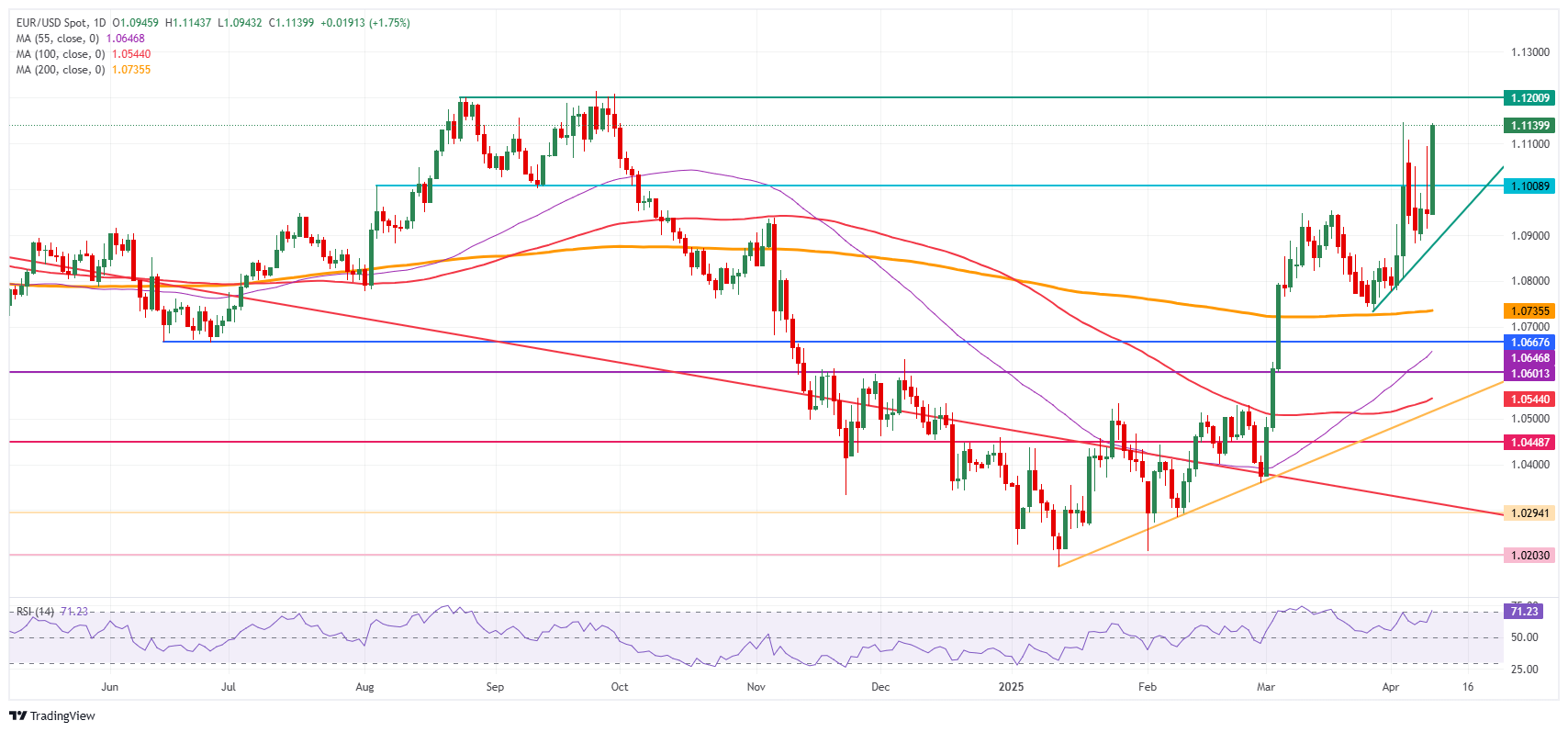
EUR/USD: Daily Chart
Inflation FAQs
Inflation measures the rise in the price of a representative basket of goods and services. Headline inflation is usually expressed as a percentage change on a month-on-month (MoM) and year-on-year (YoY) basis. Core inflation excludes more volatile elements such as food and fuel which can fluctuate because of geopolitical and seasonal factors. Core inflation is the figure economists focus on and is the level targeted by central banks, which are mandated to keep inflation at a manageable level, usually around 2%.
The Consumer Price Index (CPI) measures the change in prices of a basket of goods and services over a period of time. It is usually expressed as a percentage change on a month-on-month (MoM) and year-on-year (YoY) basis. Core CPI is the figure targeted by central banks as it excludes volatile food and fuel inputs. When Core CPI rises above 2% it usually results in higher interest rates and vice versa when it falls below 2%. Since higher interest rates are positive for a currency, higher inflation usually results in a stronger currency. The opposite is true when inflation falls.
Although it may seem counter-intuitive, high inflation in a country pushes up the value of its currency and vice versa for lower inflation. This is because the central bank will normally raise interest rates to combat the higher inflation, which attract more global capital inflows from investors looking for a lucrative place to park their money.
Formerly, Gold was the asset investors turned to in times of high inflation because it preserved its value, and whilst investors will often still buy Gold for its safe-haven properties in times of extreme market turmoil, this is not the case most of the time. This is because when inflation is high, central banks will put up interest rates to combat it. Higher interest rates are negative for Gold because they increase the opportunity-cost of holding Gold vis-a-vis an interest-bearing asset or placing the money in a cash deposit account. On the flipside, lower inflation tends to be positive for Gold as it brings interest rates down, making the bright metal a more viable investment alternative.
Forex News
Keep up with the financial markets, know what's happening and what is affecting the markets with our latest market updates. Analyze market movers, trends and build your trading strategies accordingly.