
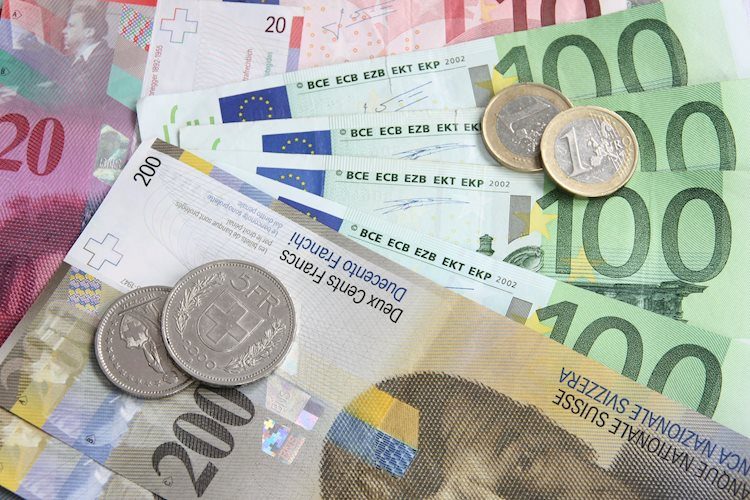

Swiss Franc strengthens against US Dollar after dovish comments by Fed's Goolsbee
- The Swiss Franc weakens marginally against the US Dollar on Thursday after the release of US inflation data.
- The data shows headline inflation coming out at 3.4%, beating estimates and previous results.
- Core inflation, however, shows less upside pressure and moderates down YoY.
The Swiss Franc (CHF) has eked out gains against the US Dollar (USD) on Thursday after sinking by half a percentage point earlier in the session. Dovish comments by the president of the Chicago Federal Reserve, Austan Goolsbee, led the US Dollar to sell off later in the day, allowing the CHF to gain strength in relation to the Greenback. Goolsbee said that 2023 was a "hall of fame" year for reducing inflation despite December's stickier reading.
The release of mostly higher-than-expected US inflation data caused the morning's USD strength as the data suggested that the central bank may delay cutting interest rates in order to keep up its war against inflation. Since higher interest rates attract more foreign capital inflows, the news is bullish for the US Dollar.
The Swiss Franc is also largely even against the Euro and Pound Sterling despite earlier weakness.
Daily digest market movers: Swiss Franc recoups early losses on Thursday
- The Swiss Franc edges down against the US Dollar after US inflation data for the month of December shows continued price pressures.
- The Consumer Price Index (CPI) for December showed a 3.4% rise YoY in December, which was above the 3.2% forecast and the 3.1% registered in November.
- CPI on a monthly basis, came out at 0.3% compared to analysts’ estimates of 0.2%.
- Annual Core CPI came out slightly lower at 3.9%, compared to the 4.0% of November, but this was still more than the 3.8% expected.
- With a rise of 0.3%, Core CPI on a monthly basis came out in line with expectations and the same as the 0.3% in November.
- The release of the CPI data led to a slight fall in the market-gauged probabilities of the Federal Reserve cutting interest rates at its meeting in March 2024, from the upper 60s% to the lower 60s%.
- That the odds still favor a Fed rate cut in March, however, still stands in contrast to the Swiss National Bank (SNB), which remains silent on the subject of bringing down interest rates.
- At the SNB’s last monetary policy meeting in December, the SNB Chairperson Thomas Jordan, avoided committing to cutting rate cuts, giving vague reasons relating to geopolitical risks.
Swiss Franc technical analysis: USD/CHF in long-term downtrend
USD/CHF – the number of Swiss Francs (CHF) that one US Dollar (USD) can buy – rises on Thursday, extending the pair’s short-term recovery rally.
The USD/CHF pair is in a long-term downtrend, however, suggesting the pair is at risk of recapitulating and continuing lower.
-638405845748990229.png)
US Dollar vs Swiss Franc: 4-hour Chart
The four-hour chart shows the pair pulling back after bottoming at the late November lows. The short-term trend is indeterminate, and given the broader bearish bias ultimately at risk of resuming its downtrend.
The recovery since the November lows has stalled and appears trapped in a range. The speed of ascent of the recovery is slower than the down move that preceded it – a further sign of weakness.
A break below the December consolidation range lows at 0.8465 would probably indicate a resumption of the downtrend back down to the November lows at 0.8332.
It would take a break above the major trendline for the downmove at around 0.8600 to confirm a change in the short-term trend and more upside. But the next target after that would be the 200-four-hour Simple Moving Average (SMA) not much higher at circa 0.8630.
Central banks FAQs
What does a central bank do?
Central Banks have a key mandate which is making sure that there is price stability in a country or region. Economies are constantly facing inflation or deflation when prices for certain goods and services are fluctuating. Constant rising prices for the same goods means inflation, constant lowered prices for the same goods means deflation. It is the task of the central bank to keep the demand in line by tweaking its policy rate. For the biggest central banks like the US Federal Reserve (Fed), the European Central Bank (ECB) or the Bank of England (BoE), the mandate is to keep inflation close to 2%.
What does a central bank do when inflation undershoots or overshoots its projected target?
A central bank has one important tool at its disposal to get inflation higher or lower, and that is by tweaking its benchmark policy rate, commonly known as interest rate. On pre-communicated moments, the central bank will issue a statement with its policy rate and provide additional reasoning on why it is either remaining or changing (cutting or hiking) it. Local banks will adjust their savings and lending rates accordingly, which in turn will make it either harder or easier for people to earn on their savings or for companies to take out loans and make investments in their businesses. When the central bank hikes interest rates substantially, this is called monetary tightening. When it is cutting its benchmark rate, it is called monetary easing.
Who decides on monetary policy and interest rates?
A central bank is often politically independent. Members of the central bank policy board are passing through a series of panels and hearings before being appointed to a policy board seat. Each member in that board often has a certain conviction on how the central bank should control inflation and the subsequent monetary policy. Members that want a very loose monetary policy, with low rates and cheap lending, to boost the economy substantially while being content to see inflation slightly above 2%, are called ‘doves’. Members that rather want to see higher rates to reward savings and want to keep a lit on inflation at all time are called ‘hawks’ and will not rest until inflation is at or just below 2%.
Is there a president or head of a central bank?
Normally, there is a chairman or president who leads each meeting, needs to create a consensus between the hawks or doves and has his or her final say when it would come down to a vote split to avoid a 50-50 tie on whether the current policy should be adjusted. The chairman will deliver speeches which often can be followed live, where the current monetary stance and outlook is being communicated. A central bank will try to push forward its monetary policy without triggering violent swings in rates, equities, or its currency. All members of the central bank will channel their stance toward the markets in advance of a policy meeting event. A few days before a policy meeting takes place until the new policy has been communicated, members are forbidden to talk publicly. This is called the blackout period.
Forex News
Keep up with the financial markets, know what's happening and what is affecting the markets with our latest market updates. Analyze market movers, trends and build your trading strategies accordingly.