

Gold price bulls retain control amid trade jitters, Fed rate cut bets and weaker USD
- Gold price regains positive traction as US tariff uncertainty continues to underpin safe-haven assets.
- Bets for aggressive Fed rate cuts in 2025 keep the USD depressed and also benefit the XAU/USD pair.
- Trump's temporary tariff reprieve improves global risk sentiment and might cap the commodity.
Gold price (XAU/USD) maintains its bid tone through the first half of the European session on Tuesday and currently trades around the $3,230 area, well within striking distance of the all-time peak touched the previous day. Investors remain concerned about the potential economic fallout from the rapidly escalating US-China trade war, which, in turn, is seen as a key factor that continues to underpin the safe-haven bullion.
Moreover, expectations that a tariffs-driven US economic slowdown might force the Federal Reserve (Fed) to cut interest rates more aggressively in 2025 and the bearish sentiment surrounding the US Dollar (USD) further benefits the non-yielding Gold price. Meanwhile, the optimism led by US President Donald Trump's temporary tariff reprieve holds back the XAU/USD bulls from placing fresh bets and caps the upside.
Daily Digest Market Movers: Gold price continues to benefits from US tariffs uncertainty, Fed rate cut bets
- Concerns about the potential economic fallout from US President Donald Trump's aggressive trade policies continue to underpin safe-haven assets. Meanwhile, China increased tariffs on US imports to 125% on Friday in retaliation to Trump's decision to raise duties on Chinese goods to an unprecedented 145%. This keeps the Gold price close to the all-time peak touched on Monday.
- The US still imports several hard-to-replace materials from China and the developments seem to have weakened confidence in the US economy. Moreover, heightened concerns over a US recession, along with bets that the Federal Reserve (Fed) would resume its rate-cutting cycle soon and lower borrowing costs at least three times in 2025, fail to assist the US Dollar in registering any meaningful recovery.
- Fed Governor Christopher Waller said the Trump administration's tariffs posed a significant shock to the US economy that might force the US central bank to cut rates to avert a recession. Separately, Atlanta Fed President Raphael Bostic noted that we still have a ways to go on inflation as tariffs could place upward pressure on prices. The Fed is unable to make bold moves in any direction, Bostic added.
- The global risk sentiment improved after the White House announced on Friday that smartphones, computers, and other electronics would be temporarily exempted from Trump’s punishing reciprocal tariffs. Furthermore, Trump said on Monday that he was looking into possible exemptions for the auto industry from the 25% tariffs as companies need more time to transition to US-made parts.
- Trump, however, said that exemptions were temporary and added that he would unveil tariffs on imported semiconductors over the next week. Trump also threatened that he would impose tariffs on pharmaceuticals in the not-too-distant future. This continues to fuel uncertainty, which, along with the underlying bearish sentiment surrounding the USD, lends some support to the XAU/USD pair.
- Traders now look to Tuesday's US economic docket, featuring the release of the Empire State Manufacturing Index. This, along with trade-related developments, might influence the USD and provide some impetus to the commodity. The focus, however, remains on Fed Chair Jerome Powell's speech on Wednesday, which might offer cues about the future rate-cut path and drive the non-yielding yellow metal.
Gold price seems poised to appreciate further; move towards retesting all-time peak remains on the cards
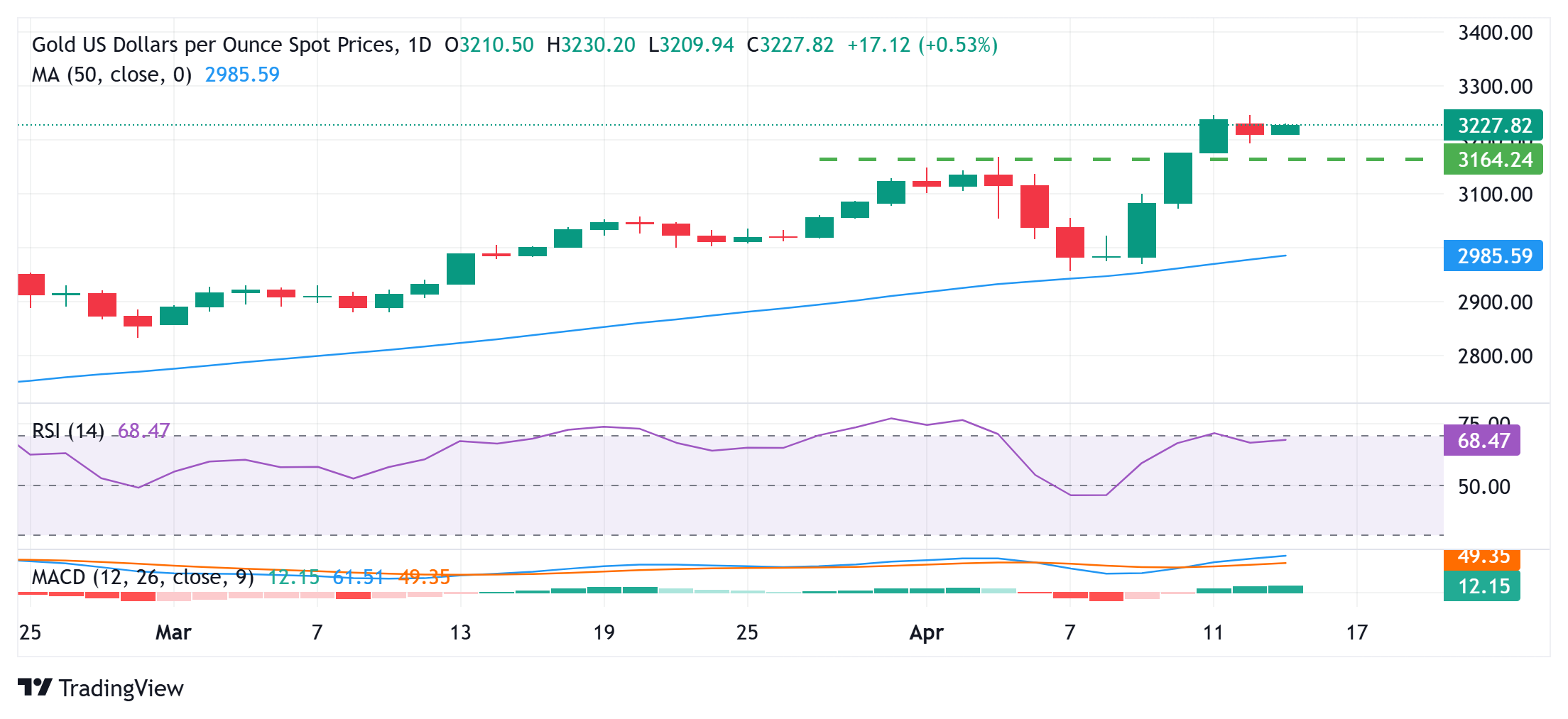
From a technical perspective, the overnight bullish resilience below the $3,200 mark and the subsequent move up suggest that the recent well-established uptrend for the Gold price is still far from being over. However, the daily Relative Strength Index (RSI) remains close to the overbought territory and makes it prudent to wait for some near-term consolidation or a modest pullback before positioning for any further gains. Hence, any further strength is more likely to confront stiff resistance near the $3,245-3,246 area, or the record high touched on Monday.
On the flip side, weakness below the $3,200 round figure might still be seen as a buying opportunity and is more likely to remain cushioned near the $3,168-3,167 region. The latter should act as a strong base and a key pivotal point for short-term traders, which if broken decisively could pave the way for a deeper corrective slide. Gold price might then fall to the $3,136 intermediate support en route to the $3,115 region and the $3,100 mark.
Fed FAQs
Monetary policy in the US is shaped by the Federal Reserve (Fed). The Fed has two mandates: to achieve price stability and foster full employment. Its primary tool to achieve these goals is by adjusting interest rates. When prices are rising too quickly and inflation is above the Fed’s 2% target, it raises interest rates, increasing borrowing costs throughout the economy. This results in a stronger US Dollar (USD) as it makes the US a more attractive place for international investors to park their money. When inflation falls below 2% or the Unemployment Rate is too high, the Fed may lower interest rates to encourage borrowing, which weighs on the Greenback.
The Federal Reserve (Fed) holds eight policy meetings a year, where the Federal Open Market Committee (FOMC) assesses economic conditions and makes monetary policy decisions. The FOMC is attended by twelve Fed officials – the seven members of the Board of Governors, the president of the Federal Reserve Bank of New York, and four of the remaining eleven regional Reserve Bank presidents, who serve one-year terms on a rotating basis.
In extreme situations, the Federal Reserve may resort to a policy named Quantitative Easing (QE). QE is the process by which the Fed substantially increases the flow of credit in a stuck financial system. It is a non-standard policy measure used during crises or when inflation is extremely low. It was the Fed’s weapon of choice during the Great Financial Crisis in 2008. It involves the Fed printing more Dollars and using them to buy high grade bonds from financial institutions. QE usually weakens the US Dollar.
Quantitative tightening (QT) is the reverse process of QE, whereby the Federal Reserve stops buying bonds from financial institutions and does not reinvest the principal from the bonds it holds maturing, to purchase new bonds. It is usually positive for the value of the US Dollar.
Forex News
Keep up with the financial markets, know what's happening and what is affecting the markets with our latest market updates. Analyze market movers, trends and build your trading strategies accordingly.