


Japanese Yen sticks to modest intraday losses against USD; bullish potential seems intact
- The Japanese Yen is undermined by receding safe-haven demand amid a positive risk tone.
- Concerns about Trump’s tariffs and hopes for a US-Japan trade deal could limit JPY losses.
- The divergent BoJ-Fed policy expectations further contribute to capping the USD/JPY pair.
The Japanese Yen (JPY) remains on the back foot against its American counterpart heading into the European session on Tuesday. US President Donald Trump's tariff reprieve on consumer electronics and signal that he may temporarily exempt the auto industry from the 25% levies remain supportive of the upbeat market mood. This, in turn, is seen undermining the safe-haven JPY. However, a combination of supporting factors should help limit the downside and warrants some caution before placing aggressive JPY bearish bets.
Concerns that the rapidly escalating US-China trade war would dent global economic growth, along with hopes that Japan might strike a trade deal with the US, might continue to act as a tailwind for the JPY. Furthermore, investors seem convinced that the Bank of Japan (BoJ) will continue raising interest rates, which marks a big divergence in comparison to bets for more aggressive policy easing by the Federal Reserve (Fed). This, in turn, keeps the US Dollar (USD) depressed and should further benefit the lower-yielding JPY.
Japanese Yen bulls remain on the sidelines amid receding safe-haven demand; downside seems limited
- On Monday, US President Donald Trump said that he was looking into possible exemptions for the auto industry from the 25% tariffs as car companies need a little bit of time to transition to US-made parts. This comes after the White House announced that smartphones, computers, and other electronics imported largely from China would be temporarily exempted from Trump’s punishing reciprocal tariffs.
- Moreover, the rest of the world would be given a 90-day reprieve on additional duties beyond the new 10% tariffs. Trump, however, said that exemptions were only temporary and added that he would unveil tariffs on imported semiconductors over the next week. Trump also threatened that he would impose tariffs on pharmaceuticals in the not-too-distant future and kept in place 145% duties on Chinese imports.
- Investors pared their bets for early interest rate hikes by the Bank of Japan on the back of increasing uncertainty over US tariff policy. The BoJ, however, is still expected to raise the policy rate amid rising domestic prices and wages. In contrast, the markets have been pricing in the possibility that the Federal Reserve will resume its rate-cutting cycle soon amid a tariffs-driven US economic slowdown.
- Fed Governor Christopher Waller said the Trump administration's tariffs posed a significant shock to the US economy that might force the US central bank to cut rates to avert a recession. Separately, Atlanta Fed President Raphael Bostic noted that we still have a ways to go on inflation as tariffs could place upward pressure on prices. The Fed is unable to make bold moves in any direction, Bostic added.
- Meanwhile, market players remain optimistic about a positive outcome from US-Japan trade talks. In fact, Trump said last week that tough but fair parameters are being set for a negotiation. Adding to this, US Treasury Secretary Scott Bessent said that Japan may be a priority in tariff negotiations, fueling hopes for a US-Japan trade deal. This should continue to act as a tailwind for the Japanese Yen.
- Tuesday's US economic docket features the release of the Empire State Manufacturing Index, which, along with trade-related developments, might influence the US Dollar. The focus, however, will remain glued to Fed Chair Jerome Powell's speech on Wednesday, which will be scrutinized for cues about the future rate-cut path. This, in turn, will influence the USD and provide a fresh impetus to the USD/JPY pair.
USD/JPY might struggle to build on intraday gains beyond the 144.00 pivotal resistance; not out of the woods yet
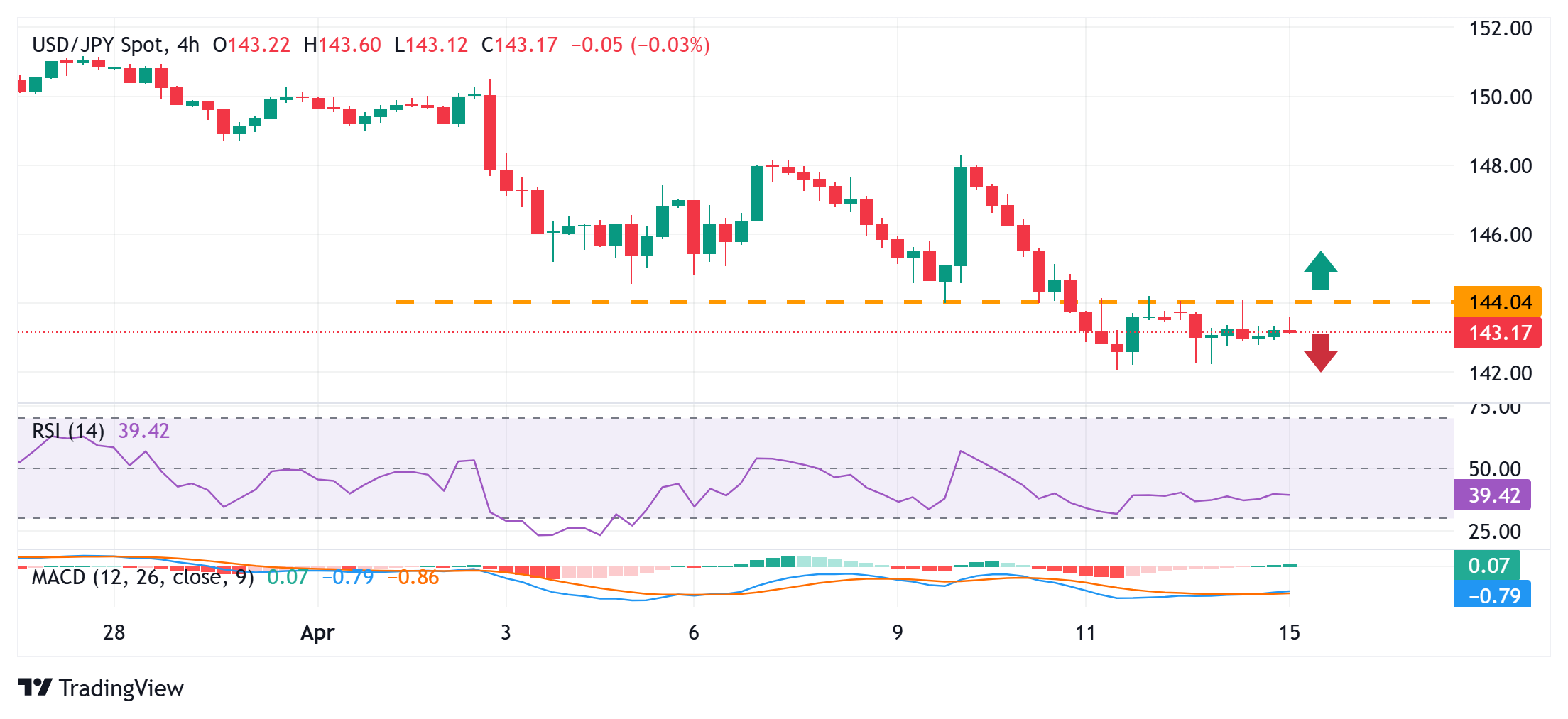
From a technical perspective, any subsequent move-up is likely to confront stiff resistance and cap the USD/JPY pair near the 144.00 mark, or the overnight swing high. A sustained strength beyond, however, might trigger a short-covering rally and lift spot prices to the 144.45-144.50 horizontal barrier en route to the 145.00 psychological mark. The momentum could extend further towards the 145.50 zone and the 146.00 round figure.
On the flip side, weakness back below the 143.00 mark now seems to find some support near the 142.25-142.20 area ahead of the 142.00 mark, or a multi-month low touched last Friday. A convincing break below would be seen as a fresh trigger for bearish traders and drag the USD/JPY pair to the 141.65-141.60 support en route to the 141.00 mark. The subsequent fall would expose the 140.75 support and the September 2024 swing low, around the 140.30-140.25 region, before spot prices eventually drop to the 140.00 psychological mark.
Bank of Japan FAQs
The Bank of Japan (BoJ) is the Japanese central bank, which sets monetary policy in the country. Its mandate is to issue banknotes and carry out currency and monetary control to ensure price stability, which means an inflation target of around 2%.
The Bank of Japan embarked in an ultra-loose monetary policy in 2013 in order to stimulate the economy and fuel inflation amid a low-inflationary environment. The bank’s policy is based on Quantitative and Qualitative Easing (QQE), or printing notes to buy assets such as government or corporate bonds to provide liquidity. In 2016, the bank doubled down on its strategy and further loosened policy by first introducing negative interest rates and then directly controlling the yield of its 10-year government bonds. In March 2024, the BoJ lifted interest rates, effectively retreating from the ultra-loose monetary policy stance.
The Bank’s massive stimulus caused the Yen to depreciate against its main currency peers. This process exacerbated in 2022 and 2023 due to an increasing policy divergence between the Bank of Japan and other main central banks, which opted to increase interest rates sharply to fight decades-high levels of inflation. The BoJ’s policy led to a widening differential with other currencies, dragging down the value of the Yen. This trend partly reversed in 2024, when the BoJ decided to abandon its ultra-loose policy stance.
A weaker Yen and the spike in global energy prices led to an increase in Japanese inflation, which exceeded the BoJ’s 2% target. The prospect of rising salaries in the country – a key element fuelling inflation – also contributed to the move.
Forex News
Keep up with the financial markets, know what's happening and what is affecting the markets with our latest market updates. Analyze market movers, trends and build your trading strategies accordingly.