


Gold price bulls have the upper hand amid rising US-China trade tensions; US CPI report in focus
- Gold price continues to attract safe-haven flows amid rising US-China trade tensions.
- Bets for multiple Fed rate cuts weigh on the USD and also benefit the precious metal.
- A solid recovery in the risk sentiment fails to undermine the safe-haven XAU/USD pair.
Gold price (XAU/USD) retreats after touching a fresh weekly high during the early European session on Thursday, though it sticks to positive bias for the second straight day and holds above the $3,100 mark. Concerns about escalating US-China trade tensions, along with fears about a tariffs-driven global economic slowdown, continue to underpin the safe-haven bullion. Apart from this, higher inflationary expectations further benefit the precious metal's status as a hedge against rising prices.
Meanwhile, rising bets for multiple interest rate cuts by the Federal Reserve (Fed) in 2025, along with the emergence of fresh US Dollar (USD) selling, turn out to be another factor lending support to the non-yielding Gold price. The XAU/USD bulls, however, refrain from placing fresh bets amid a solid recovery in the global risk sentiment, bolstered by US President Donald Trump's tariffs pause. Traders also seem reluctant ahead of the release of the US consumer inflation figures.
Daily Digest Market Movers: Gold price retains positive bias amid escalating US-China trade war, ahead of US CPI report
- In less than 24 hours after steep new tariffs kicked in on Wednesday, US President Donald Trump abruptly took a U-turn and announced a 90-day pause on hefty duties on most nations for 90 days. Trump, however, jacked up the tax rate on goods from China to 125% after the latter declared that it is putting an additional 50% tariff on US imports.
- Investors now seem worried that an all-out trade war between the world's two largest economies would stoke inflation and
- hinder global growth. This, in turn, assisted the safe-haven Gold price to rise more than 2% on Wednesday and post its best day since October 2023. The momentum seems unaffected by a sharp recovery in equity markets.
- Traders slashed their bets for more aggressive rate cuts by the Federal Reserve (Fed) after March FOMC meeting minutes revealed that officials unanimously agreed that the US economy was at risk of experiencing higher inflation. Adding to this, a slew of influential Fed policymakers called for a cautious approach to interest rate cuts.
- Minneapolis Fed President Neel Kashkari said that the bar for cutting rates remains high as tariffs can lead to inflation. Adding to this, Cleveland Fed President Beth Hammack noted that monetary policy is modestly restrictive right now, though he would prefer to wait than move in the wrong direction with interest rates.
- Separately, Richmond Fed President Tom Barkin warned that tariff price hikes could begin by June and price surges require the US central bank to be cautious. Furthermore, St. Louis Fed President Alberto Musalem said that it is risky to assume the Fed can look through higher prices from tariffs, there is a chance some effects could persist.
- Traders were quick to react and are now pricing in the possibility that the Fed will resume its rate-cutting cycle in June and deliver just 75 basis points of rate reductions over the course of the year. This, however, does little to assist the US Dollar to capitalize on the overnight bounce or attract any sellers around the non-yielding yellow metal.
- Investors now look forward to the release of the US consumer inflation figures, which will be followed by the US Producer Price Index (PPI) on Friday, for fresh cues about the Fed's rate-cut path. This, in turn, will play a key role in influencing the near-term USD price dynamics and providing a fresh directional impetus to the XAU/USD pair.
Gold price bullish technical setup supports prospects for the emergence of dip-buyers below the $3,100 mark
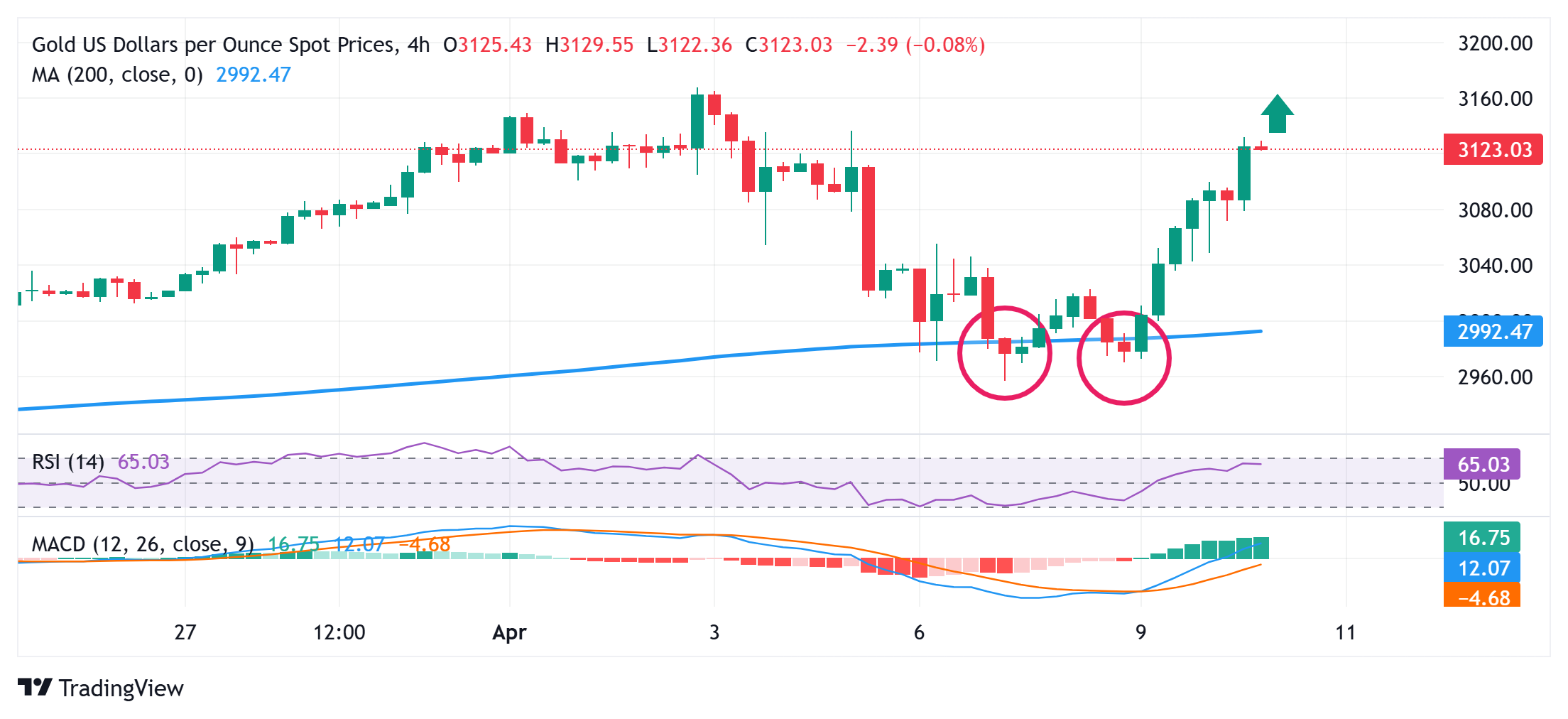
From a technical perspective, the commodity showed some resilience below the 200-period Simple Moving Average (SMA) earlier this week and the subsequent move higher favors bullish traders. Moreover, positive oscillators on the daily chart support prospects for a further appreciating move for the Gold price. Hence, some follow-through strength towards retesting the all-time peak, around the $3,167-3,168 region touched earlier this month, looks like a distinct possibility.
On the flip side, weakness back below the $3,100 mark might now find decent support near the $3,065-3,060 region. The said area should act as a key pivotal point, which if broken decisively could make the Gold price vulnerable to accelerate the fall back towards the $3,000 psychological mark. The latter now coincides with the 200-period SMA on the 4-hour chart, which should act as a key pivotal point and if broken decisively, might shift the near-term bias in favor of bearish traders.
Fed FAQs
Monetary policy in the US is shaped by the Federal Reserve (Fed). The Fed has two mandates: to achieve price stability and foster full employment. Its primary tool to achieve these goals is by adjusting interest rates. When prices are rising too quickly and inflation is above the Fed’s 2% target, it raises interest rates, increasing borrowing costs throughout the economy. This results in a stronger US Dollar (USD) as it makes the US a more attractive place for international investors to park their money. When inflation falls below 2% or the Unemployment Rate is too high, the Fed may lower interest rates to encourage borrowing, which weighs on the Greenback.
The Federal Reserve (Fed) holds eight policy meetings a year, where the Federal Open Market Committee (FOMC) assesses economic conditions and makes monetary policy decisions. The FOMC is attended by twelve Fed officials – the seven members of the Board of Governors, the president of the Federal Reserve Bank of New York, and four of the remaining eleven regional Reserve Bank presidents, who serve one-year terms on a rotating basis.
In extreme situations, the Federal Reserve may resort to a policy named Quantitative Easing (QE). QE is the process by which the Fed substantially increases the flow of credit in a stuck financial system. It is a non-standard policy measure used during crises or when inflation is extremely low. It was the Fed’s weapon of choice during the Great Financial Crisis in 2008. It involves the Fed printing more Dollars and using them to buy high grade bonds from financial institutions. QE usually weakens the US Dollar.
Quantitative tightening (QT) is the reverse process of QE, whereby the Federal Reserve stops buying bonds from financial institutions and does not reinvest the principal from the bonds it holds maturing, to purchase new bonds. It is usually positive for the value of the US Dollar.
Forex News
Keep up with the financial markets, know what's happening and what is affecting the markets with our latest market updates. Analyze market movers, trends and build your trading strategies accordingly.