

Mexican Peso's upside attempts remain capped below the 20.00 level
- The Mexican peso failed again at 20.00 level before turning negative on the daily chart.
- MXN fails to draw support from lower US Treasury yields and weak US manufacturing figures.
- The USD/MXN needs an additional impulse to break the 20.00 level.
The Mexican Peso (MXN) has given away the moderate gains seen at the week opening and is retreating again from the 20.00 level. The US Dollar (USD) has taken back lost ground following a soft week opening as US Treasury yields retreated from last week's highs and kept trading higher, unfazed by the negative manufacturing data.
The NY Empire State Manufacturing Index dropped to 0.2 in December from 31.2% in the previous month, beyond the 12 reading expected. In less than one hour, the US preliminary Purchasing Managers Index (PMI) data is expected to confirm that manufacturing activity softened in December, with the services sector expanding at a slower pace than in the previous month.
These figures would be consistent with the view of a Federal Reserve (Fed) rate cut on Wednesday, although the market is likely to wait for some more insight into the central bank’s forward guidance before making investment decisions.
In Mexico, macroeconomic data was disappointing last week. Consumer inflation dropped beyond expectations and consumer confidence and industrial output disappointed. The macroeconomic backdrop remains resilient, with unemployment at low levels, but concerns that higher tariffs by Trump’s administration next year will hurt growth and will likely pressure the Bank of Mexico (Banxico) to cut rates by 25 bps on Thursday.
Daily digest market movers: US Dollar rally falters as the Fed decision approaches
- The US Dollar Index (DXY) has stalled near three-week highs and is trimming some gains on Monday as investors take profits awaiting the Fed’s monetary policy decision, due on Wednesday.
- US Treasury yields have pulled back from last week’s highs, undermining support for the USD. The yield of the benchmark 10-year note has retreated from 4.40% after having rallied continuously for the previous five trading days.
- US economic data released last week were mixed. Consumer inflation remained steady above the Fed’s 2% target rate, producer prices accelerated, but jobless claims increased against market expectations.
- The CME Fed Watch tool shows that the market is nearly fully pricing a 25 basis point (bps) rate cut by the Fed after Wednesday’s meeting. For next year, however, the market is pricing a 60% chance that the central bank will cut rates once or twice.
- Later today, the NY Empire State Manufacturing Index is expected to show a moderate deterioration in the manufacturing conditions, to a 12 leading from 31.2 in November.
- A few hours later, the preliminary US S&P Global Manufacturing PMI is expected to show a moderate decline to 49.4 in December from 49.7 last month. Services activity is seen slowing down to 55.7 from 56.1.
Mexican Peso technical outlook: USD/MXN has strong support at the 20.00 area
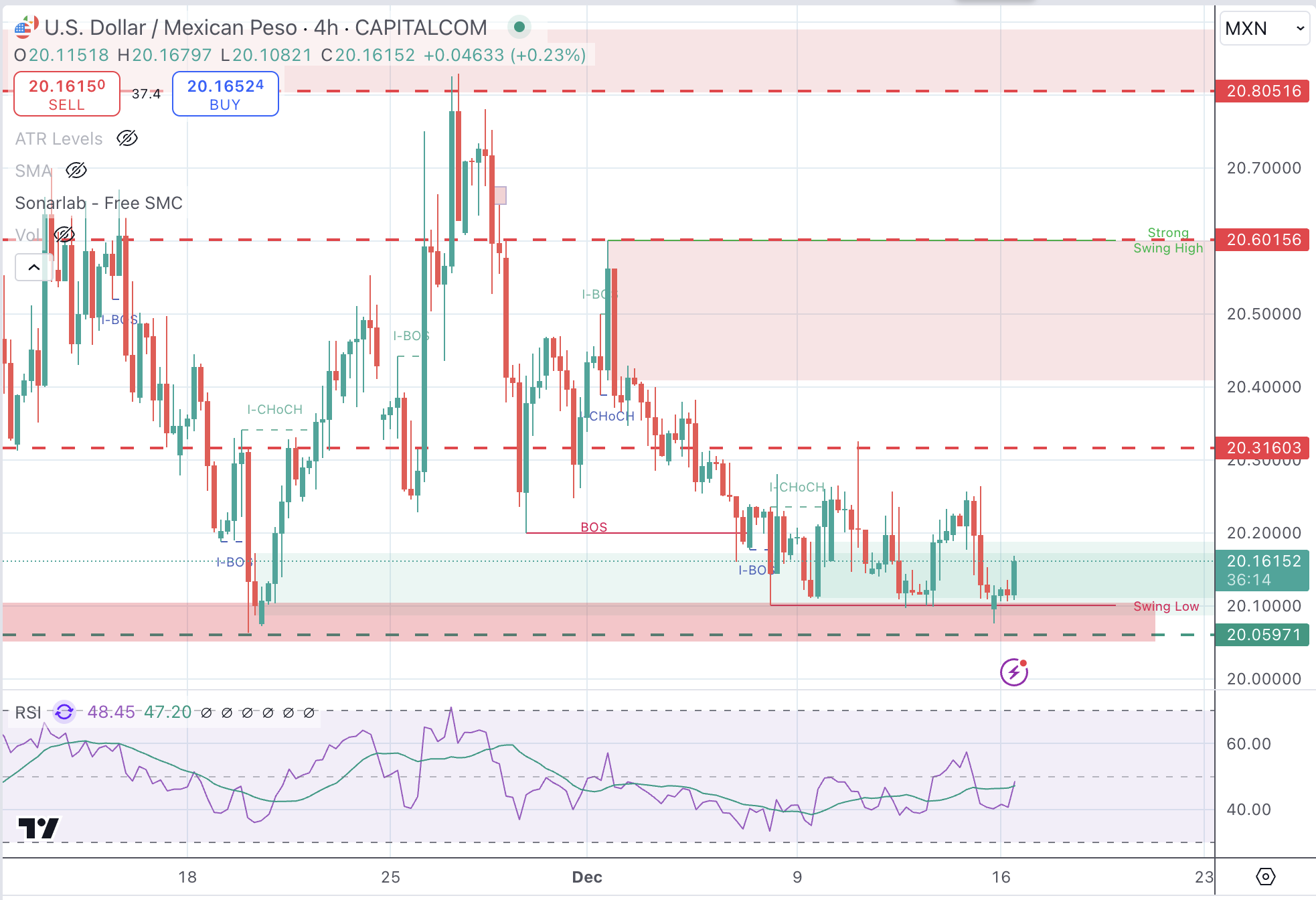
The USD/MXN is picking up from the 20.00 psychological level but remains trapped within last week's trading channel. The pair has been moving back and forth between the mentioned 20.00 support and 20.30 on the upside since retreating from 20.60 in early December.
The Mexican Peso needs an additional impulse to breach the key 20.00 level against the US Dollar and shift its focus toward the October 24 and 25 and November 7 lows, at 19.75
On the upside, the USD needs to confirm above 20.30 before aiming for the December 2 high at 20.60 and November’s peak at around 20.80.
US Dollar PRICE Today
The table below shows the percentage change of US Dollar (USD) against listed major currencies today. US Dollar was the strongest against the Australian Dollar.
| USD | EUR | GBP | JPY | CAD | AUD | NZD | CHF | |
|---|---|---|---|---|---|---|---|---|
| USD | 0.11% | -0.23% | 0.11% | 0.05% | 0.14% | 0.02% | -0.10% | |
| EUR | -0.11% | -0.30% | 0.10% | 0.01% | 0.20% | -0.01% | -0.15% | |
| GBP | 0.23% | 0.30% | 0.25% | 0.29% | 0.46% | 0.23% | 0.11% | |
| JPY | -0.11% | -0.10% | -0.25% | -0.07% | 0.04% | -0.07% | -0.15% | |
| CAD | -0.05% | -0.01% | -0.29% | 0.07% | 0.14% | -0.03% | -0.18% | |
| AUD | -0.14% | -0.20% | -0.46% | -0.04% | -0.14% | -0.21% | -0.37% | |
| NZD | -0.02% | 0.01% | -0.23% | 0.07% | 0.03% | 0.21% | -0.16% | |
| CHF | 0.10% | 0.15% | -0.11% | 0.15% | 0.18% | 0.37% | 0.16% |
The heat map shows percentage changes of major currencies against each other. The base currency is picked from the left column, while the quote currency is picked from the top row. For example, if you pick the US Dollar from the left column and move along the horizontal line to the Japanese Yen, the percentage change displayed in the box will represent USD (base)/JPY (quote).
USD/MXN 4-Hour Chart
Mexican Peso FAQs
The Mexican Peso (MXN) is the most traded currency among its Latin American peers. Its value is broadly determined by the performance of the Mexican economy, the country’s central bank’s policy, the amount of foreign investment in the country and even the levels of remittances sent by Mexicans who live abroad, particularly in the United States. Geopolitical trends can also move MXN: for example, the process of nearshoring – or the decision by some firms to relocate manufacturing capacity and supply chains closer to their home countries – is also seen as a catalyst for the Mexican currency as the country is considered a key manufacturing hub in the American continent. Another catalyst for MXN is Oil prices as Mexico is a key exporter of the commodity.
The main objective of Mexico’s central bank, also known as Banxico, is to maintain inflation at low and stable levels (at or close to its target of 3%, the midpoint in a tolerance band of between 2% and 4%). To this end, the bank sets an appropriate level of interest rates. When inflation is too high, Banxico will attempt to tame it by raising interest rates, making it more expensive for households and businesses to borrow money, thus cooling demand and the overall economy. Higher interest rates are generally positive for the Mexican Peso (MXN) as they lead to higher yields, making the country a more attractive place for investors. On the contrary, lower interest rates tend to weaken MXN.
Macroeconomic data releases are key to assess the state of the economy and can have an impact on the Mexican Peso (MXN) valuation. A strong Mexican economy, based on high economic growth, low unemployment and high confidence is good for MXN. Not only does it attract more foreign investment but it may encourage the Bank of Mexico (Banxico) to increase interest rates, particularly if this strength comes together with elevated inflation. However, if economic data is weak, MXN is likely to depreciate.
As an emerging-market currency, the Mexican Peso (MXN) tends to strive during risk-on periods, or when investors perceive that broader market risks are low and thus are eager to engage with investments that carry a higher risk. Conversely, MXN tends to weaken at times of market turbulence or economic uncertainty as investors tend to sell higher-risk assets and flee to the more-stable safe havens.
Forex News
Keep up with the financial markets, know what's happening and what is affecting the markets with our latest market updates. Analyze market movers, trends and build your trading strategies accordingly.