


EUR/USD retraces as US Dollar finds temporary support
- EUR/USD sticks to gains near 1.1500 as the US Dollar has been battered by Trump’s attack on the Fed’s independence.
- Trump blames Fed Powell for the potential US economic slowdown.
- The ECB is expected to cut interest rates in June due to escalating downside risks to Eurozone inflation.
EUR/USD retraces to near 1.1470 during North American trading hours on Tuesday from an over three-year high of 1.1575, which it posted on Monday. The major currency pair has witnessed some profit-booking as the US Dollar (USD) strives to gain ground near its recent lows. The US Dollar Index (DXY), which tracks the Greenback’s value against six major currencies, aims to find a cushion near the three-year low near 98.00.
However, the outlook of the US Dollar remains uncertain as it is expected to continue to face the burden of growing tensions between the Federal Reserve (Fed) and United States (US) President Donald Trump over the monetary policy.
US President Trump has been criticizing Fed Chair Jerome Powell for not lowering interest rates and warned that the economy could face a downturn if they are not reduced immediately.
"With these costs trending so nicely downward, just what I predicted they would do, there can almost be no inflation, but there can be a SLOWING of the economy unless Mr. Too Late, a major loser, lowers interest rates, NOW," Trump wrote in a post on TruthSocial on Monday.
Meanwhile, Jerome Powell has been supporting keeping interest rates in the current range of 4.25%-4.50% until it becomes clear whether inflation led by new economic policies is persistent or short-lived.
US President Trump has also threatened to remove Powell over a year before the completion of his term for not lowering interest rates. It is still debatable whether Donald Trump can sack Powell, but the situation will remain the same as the decision on borrowing rates will be eventually taken by other Fed members, and none of them has spoken out about easing the monetary policy immediately.
The signs of political interference in the operations of the Fed, which is an autonomous institution, have led to a steep decline in the safe-haven status of the US Dollar. Investors doubt the credibility of the US Dollar and US assets under the threat of Trump’s attack on the Fed’s independence.
Daily digest market movers: EUR/USD corrects as Euro underperforms
- The safe-haven status of the US Dollar has also been questioned due to the events of ever-changing tariff headlines by Donald Trump and his feud with Fed Chairman Powell. Trump announced a 90-day pause in executing reciprocal tariffs after getting responses from his trading partners to make a fair deal. However, the intact trade war between the US and China has kept the US Dollar on the backfoot.
- The impact of the intensified trade war between the world’s two largest powerhouses has battered the global economic outlook, including the US, given that American importers will bear the burden of higher tariffs, which they will pass on to consumers. Such a scenario will diminish households’ purchasing power significantly.
- Meanwhile, the corrective move in the EUR/USD pair is also driven by the Euro's underperformance (EUR) as traders have become increasingly confident that the European Central Bank (ECB) could cut interest rates again in the June policy meeting. ECB dovish bets have swelled on increasing downside risks to Eurozone inflation amid fears of global economic turmoil.
- Analysts at Citi anticipated price growth of 1.6% next year and 1.8% in 2027 last week before the ECB’s interest rate decision on Thursday. These predictions came before the ECB’s monetary policy announcement, in which the central bank reduced its key borrowing rates for the seventh time in the current monetary easing cycle and guided a grim economic outlook.
- In the press conference, ECB President Christine Lagarde warned that downside risks for the Eurozone economy have increased. Lagarde said that the economic outlook is "clouded by uncertainty" as trade disruptions would weigh on "business investment."
- During late European trading hours, ECB policymaker and Slovakia's central bank governor Peter Kazimir expressed confidence that inflation will come down to the desired rate of 2% in a few months. Kazimir warned about increased market uncertainty stemming from US tariff policies. "Heightened global trade tensions have introduced significant ambiguity into the system, eroding confidence," Kazimir said.
- Going forward, the next trigger for the Euro will be the preliminary Purchasing Managers’ Index (PMI) data of the Eurozone and its nations for April, which will be released on Wednesday.
Euro PRICE Today
The table below shows the percentage change of Euro (EUR) against listed major currencies today. Euro was the strongest against the Swiss Franc.
| USD | EUR | GBP | JPY | CAD | AUD | NZD | CHF | |
|---|---|---|---|---|---|---|---|---|
| USD | 0.20% | -0.08% | -0.14% | -0.06% | 0.33% | -0.01% | 0.36% | |
| EUR | -0.20% | -0.28% | -0.39% | -0.28% | 0.09% | -0.22% | 0.15% | |
| GBP | 0.08% | 0.28% | -0.09% | -0.01% | 0.38% | 0.07% | 0.43% | |
| JPY | 0.14% | 0.39% | 0.09% | 0.08% | 0.45% | 0.22% | 0.56% | |
| CAD | 0.06% | 0.28% | 0.01% | -0.08% | 0.38% | 0.06% | 0.41% | |
| AUD | -0.33% | -0.09% | -0.38% | -0.45% | -0.38% | -0.32% | 0.06% | |
| NZD | 0.01% | 0.22% | -0.07% | -0.22% | -0.06% | 0.32% | 0.38% | |
| CHF | -0.36% | -0.15% | -0.43% | -0.56% | -0.41% | -0.06% | -0.38% |
The heat map shows percentage changes of major currencies against each other. The base currency is picked from the left column, while the quote currency is picked from the top row. For example, if you pick the Euro from the left column and move along the horizontal line to the US Dollar, the percentage change displayed in the box will represent EUR (base)/USD (quote).
Technical Analysis: EUR/USD strives to return above 1.1500
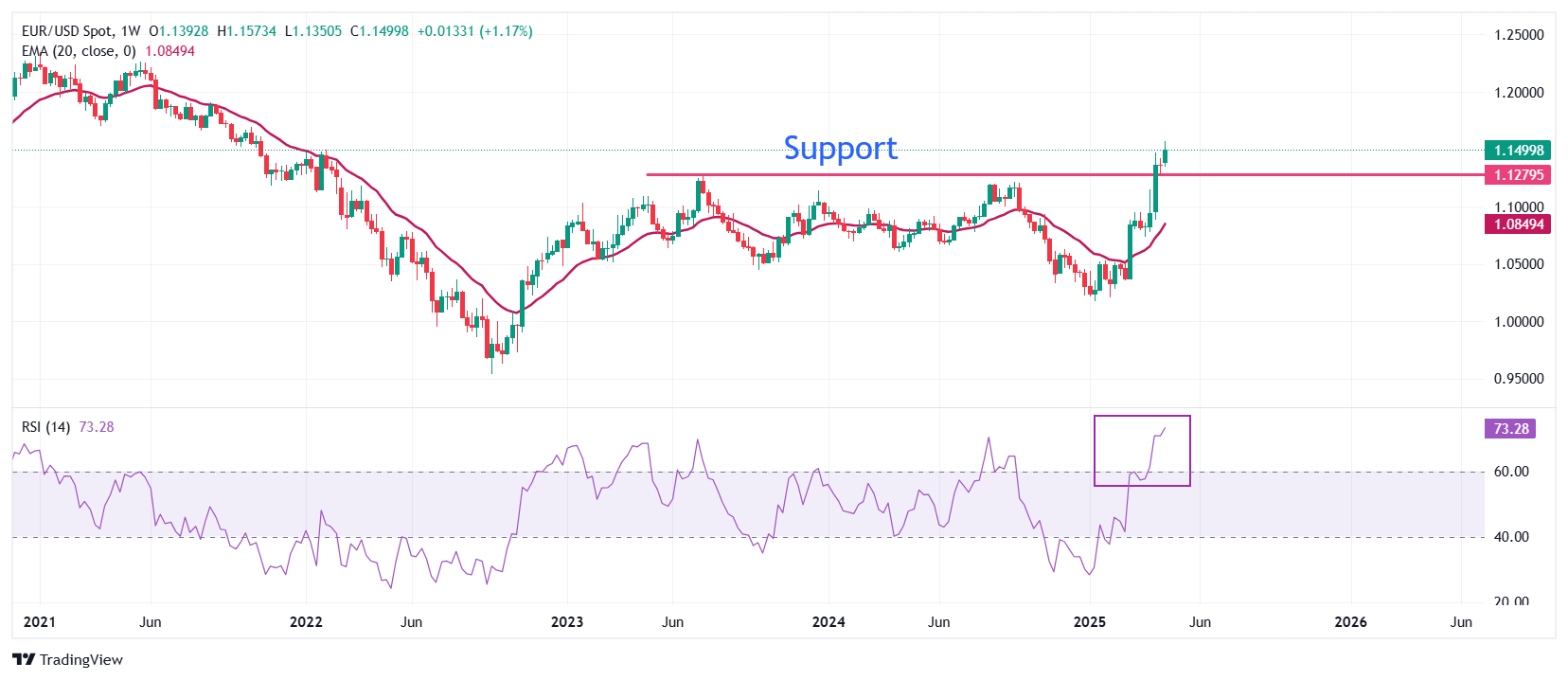
EUR/USD faces pressure above 1.1500 and falls to near 1.1470 in Tuesday’s North American session. The major currency pair has shown a strong rally in the last few weeks after a breakout above the September 25 high of 1.1215. Advancing 20-week Exponential Moving Average (EMA) near 1.0850 suggests a strong upside trend.
The 14-week Relative Strength Index (RSI) climbs to overbought levels around 75.00, which indicates a strong bullish momentum, but chances of some correction cannot be ruled out.
Looking up, the round-level figure of 1.1600 will be the major resistance for the pair. Conversely, the July 2023 high of 1.1276 will be a key support for the Euro bulls.
Fed FAQs
Monetary policy in the US is shaped by the Federal Reserve (Fed). The Fed has two mandates: to achieve price stability and foster full employment. Its primary tool to achieve these goals is by adjusting interest rates. When prices are rising too quickly and inflation is above the Fed’s 2% target, it raises interest rates, increasing borrowing costs throughout the economy. This results in a stronger US Dollar (USD) as it makes the US a more attractive place for international investors to park their money. When inflation falls below 2% or the Unemployment Rate is too high, the Fed may lower interest rates to encourage borrowing, which weighs on the Greenback.
The Federal Reserve (Fed) holds eight policy meetings a year, where the Federal Open Market Committee (FOMC) assesses economic conditions and makes monetary policy decisions. The FOMC is attended by twelve Fed officials – the seven members of the Board of Governors, the president of the Federal Reserve Bank of New York, and four of the remaining eleven regional Reserve Bank presidents, who serve one-year terms on a rotating basis.
In extreme situations, the Federal Reserve may resort to a policy named Quantitative Easing (QE). QE is the process by which the Fed substantially increases the flow of credit in a stuck financial system. It is a non-standard policy measure used during crises or when inflation is extremely low. It was the Fed’s weapon of choice during the Great Financial Crisis in 2008. It involves the Fed printing more Dollars and using them to buy high grade bonds from financial institutions. QE usually weakens the US Dollar.
Quantitative tightening (QT) is the reverse process of QE, whereby the Federal Reserve stops buying bonds from financial institutions and does not reinvest the principal from the bonds it holds maturing, to purchase new bonds. It is usually positive for the value of the US Dollar.
BRANDED CONTENT
Finding the right broker for trading EUR/USD is crucial, and we've identified the top choices for this major currency pair. Read about their unique features to make an informed decision.
Forex News
Keep up with the financial markets, know what's happening and what is affecting the markets with our latest market updates. Analyze market movers, trends and build your trading strategies accordingly.