


Gold price rolls to nearly 3% as China retaliates and Bessent issues warnings
- Gold price jumps over 2.5% on Wednesday with US tariffs being switched on.
- China meanwhile retaliated while secretary Bessent issues a warning for China on devaluing its currency.
- Gold bounces from the sub-$3,000 region to just below $3,070 at the time of writing.
Gold price (XAU/USD) bounces higher and recovers to $3,045 at the time of writing on Wednesday after United States (US) President Donald Trump’s tariffs came into effect. At one point this week, markets were hoping for a last-minute solution as several news outlets informed on Monday that President Trump was considering a 90-day pause in tariffs for all countries except China. However, the White House stated that any suggestion that President Trump was considering a 90-day pause in tariffs was “fake news.”
“Gold’s rebound reflects growing investor anxiety over tariff threats and the potential reshaping of global trade norms,” says Christopher Wong, a foreign currency strategist at Oversea-Chinese Banking Corp. Bullion remains a good hedge against a more disorderly global economy, Wong said, Bloomberg reports. The market also speculates that heightened volatility may prompt the Federal Reserve (Fed) to speed up interest rate cuts to prevent a recession. Lower rates typically benefit Gold, which doesn’t pay interest.
Halfway through the European trading session, headlines emerge that China is retaliating against the US imposed tariffs. Chinese Finance Minister Lan Fo'an said an additional 84% of tariffs will be imposed on all US goods. The tariffs will take place as of April 10th.
United States Secretary of the Treasury Scot Bessent meanwhile said China should rather come to the table instead of retaliating. Bessent also said the country will be the biggest loser with these counter-tariffs. Bessent also called out and warned China should not devalue its currency as an additional measure to circumvent the US tariffs, Bloomberg reports.
Daily digest market movers: FOMC Minutes will not move the needle
- Shares of Muthoot Finance, an Indian financial corporation and the largest Gold loan non-bank financial company in the country, declined as much as 6.3% after the Indian central bank said it would undertake a comprehensive review of gold loan regulations, which could potentially increase competition in the sector.
- The CME FedWatch tool shows the chance of an interest rate cut by the Federal Reserve (Fed) in May’s meeting surging to 53.5%, compared with only 10.6% a week ago. For June, the chances of lower borrowing costs are 100%, with 55.2% anticipating a 50 basis point (bp) rate cut.
- Chinese investors funneled a record amount of cash into Gold-backed Exchange Traded Funds (ETFs) last week, drawn by the asset's safety as combative trade war rhetoric from the world’s biggest economies shakes global markets. Inflows to four major onshore Gold ETFs, including Huaan Yifu Gold ETF, hit a record of 7.6 billion yuan ($1 billion) last week, according to Bloomberg’s calculations, with strong inflows continuing this week, Bloomberg reports.
- Later this Wednesday, around 18:00 GMT, the Federal Open Market Committee (FOMC) will release its latest Minutes from the rate decision meeting in March.
Gold Price Technical Analysis: Will it really get resolved?
With the US tariffs taking effect this Wednesday, the markets' reaction is one still with some surprise. It seems that markets were positioned for some last-minute solution or delay, which would soften the actual blow and impact of the tariffs. Nonetheless, duties are taking effect immediately, and that is enough for last-minute investors to head back into Gold.
Looking up, resistances are a bit spread out, with the first cap of the R1 resistance at $3,041 being tested when writing, followed by $3,057, a pivotal level since March 20. Further up, the R2 resistance at $3,089 precedes the current all-time high of $3,167.
On the downside, the pivotal level of the March 14 high at $3,004 roughly coincides with the $3,000 round number. If this area does not hold as support, bears can target the S1 support at $2,964 and the $2,955 level, where clearly many buyers were interested in scooping up Gold on Monday. Further down, the S2 support at $2,945 is the last line of defense before the 55-day Simple Moving Average (SMA) at $2,935.
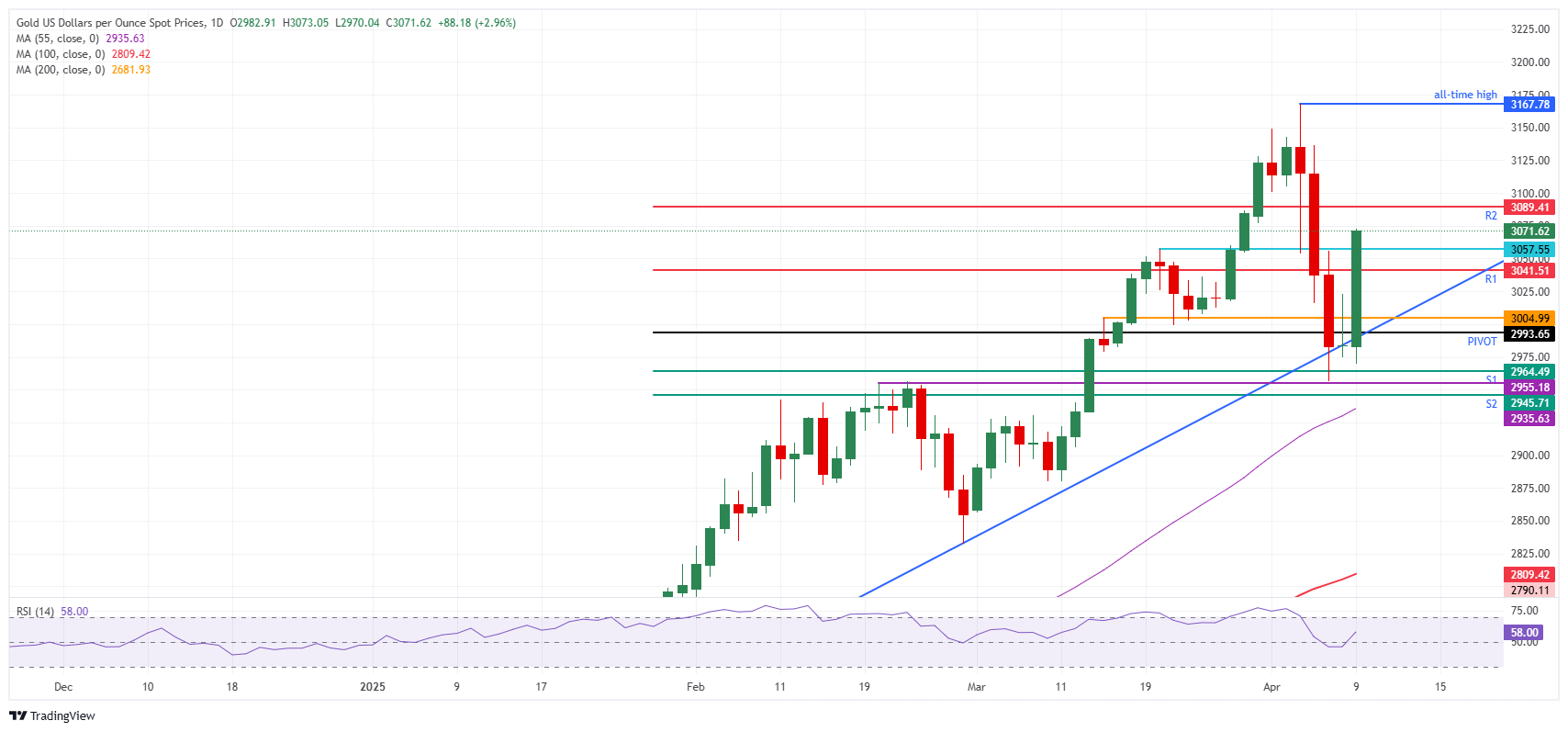
XAU/USD: Daily Chart
Interest rates FAQs
Interest rates are charged by financial institutions on loans to borrowers and are paid as interest to savers and depositors. They are influenced by base lending rates, which are set by central banks in response to changes in the economy. Central banks normally have a mandate to ensure price stability, which in most cases means targeting a core inflation rate of around 2%. If inflation falls below target the central bank may cut base lending rates, with a view to stimulating lending and boosting the economy. If inflation rises substantially above 2% it normally results in the central bank raising base lending rates in an attempt to lower inflation.
Higher interest rates generally help strengthen a country’s currency as they make it a more attractive place for global investors to park their money.
Higher interest rates overall weigh on the price of Gold because they increase the opportunity cost of holding Gold instead of investing in an interest-bearing asset or placing cash in the bank. If interest rates are high that usually pushes up the price of the US Dollar (USD), and since Gold is priced in Dollars, this has the effect of lowering the price of Gold.
The Fed funds rate is the overnight rate at which US banks lend to each other. It is the oft-quoted headline rate set by the Federal Reserve at its FOMC meetings. It is set as a range, for example 4.75%-5.00%, though the upper limit (in that case 5.00%) is the quoted figure. Market expectations for future Fed funds rate are tracked by the CME FedWatch tool, which shapes how many financial markets behave in anticipation of future Federal Reserve monetary policy decisions.
Forex News
Keep up with the financial markets, know what's happening and what is affecting the markets with our latest market updates. Analyze market movers, trends and build your trading strategies accordingly.