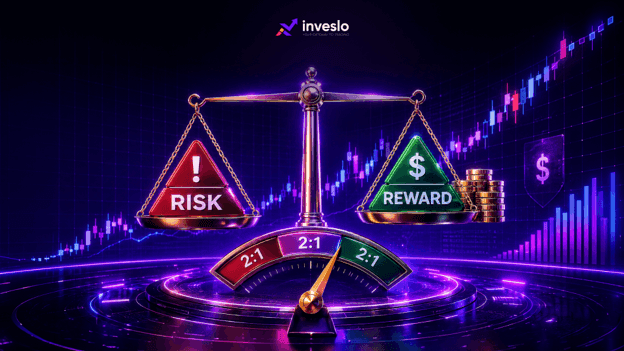
Most traders blow their first account chasing a high win rate. The risk-to-reward ratio is what they ignored, and it's usually why the money ran out. This guide covers how to calculate it, why it matters more than accuracy, and how to use it as a filter on every single trade you take. Get this right early, and you'll skip a category of mistakes that otherwise takes years to recognize.
Many traders lose money early in their trading journey by focusing too heavily on achieving a high win rate while overlooking proper risk management. One of the most important concepts they often miss is the risk to reward ratio.
The risk to reward ratio helps traders understand how much they are risking compared to their potential reward before entering a trade. It plays an important role in building discipline, managing capital effectively, and evaluating whether a trade setup is worth taking.
This guide covers how to calculate the risk to reward ratio, why it matters just as much as accuracy, and how to use it as a filter for every trade you consider. Understanding this concept early can help you avoid common mistakes and develop a more structured approach to trading.
Table of Contents
- What is the Risk to Reward Ratio?
- How to Calculate Risk to Reward Ratio
- Why This Ratio Matters More Than Win Rate
- What Is the Best Risk to Reward Ratio for Trading?
- How to Apply It in Your Trading Strategy
- The Bottom Line
- FAQ
What is Risk to Reward Ratio?
The risk to reward ratio measures how much you stand to lose on a trade relative to how much you could potentially gain. It helps traders determine, before entering a position, whether a trade has a favourable balance between potential risk and reward.
Think of it this way. If you risk 50 pips to make 100 pips, your ratio is 1:2.
Pips are the smallest standard price movement in a currency pair, typically 0.0001 for most major pairs. You're risking one unit to potentially gain two. Flip that around and risk 100 pips to make 50, and your ratio drops to 1:0.5, a setup where you'd need to be right far more often just to stay flat.
The risk-to-reward ratio does not predict whether a trade will win or lose. Instead, it helps traders evaluate whether the potential outcome of a trade makes sense over a series of trades.
A single trade can always move against you, but maintaining a favourable risk to reward approach can help create a more structured trading process.
How to Calculate Risk to Reward Ratio
Calculating your risk to reward ratio is straightforward once you've identified your entry, stop-loss, and take-profit levels. A stop-loss is the price at which your broker automatically closes a trade to limit further losses. A take-profit is where the trade closes once your target price is reached.
Follow these steps:
- Identify your entry price. This is the price at which you open the trade.
- Set your stop-loss. Measure the distance in pips between your entry and your stop-loss. This is your risk.
- Set your take-profit. Measure the distance in pips between your entry and your take-profit. This is your potential reward.
- Divide risk by reward. The formula is: Risk-to-Reward Ratio = Potential Loss ÷ Potential Profit
For example:
So if you place a trade on EUR/USD with an entry at 1.0800, a stop-loss at 1.0770, and a take-profit at 1.0890, your risk is 30 pips and your reward is 90 pips. That gives you a 1:3 ratio, one of the cleaner setups you'll encounter in forex trading.
Practical tip: Always calculate this ratio before entering a trade, not after. Once you're in a position, emotion makes it far harder to evaluate the numbers objectively.
That's the calculation. The harder part is understanding why this number matters more than most traders think.
Why This Ratio Matters More Than Win Rate
Here's what most new traders get wrong: a high win rate doesn't guarantee profitability. You can win 70% of your trades and still lose money if your losses consistently outsize your wins.
Consider this example. A trader wins 60% of their trades but risks 100 pips to make 40 every time. Over 10 trades, they win 6 (earning 240 pips) and lose 4 (losing 400 pips). Net result: minus 160 pips. By contrast, a trader winning only 40% of the time but using a 1:3 ratio wins 4 trades (earning 1,200 pips) and loses 6 (losing 600 pips). Net result: plus 600 pips.
That gap is hard to ignore.
Research into retail forex trader performance consistently shows that traders who close accounts at a loss tend to share a common pattern: large average losses relative to small average gains, regardless of their overall win rate. The ratio problem, not the accuracy problem, is the common thread.
For this reason, many experienced traders use the risk-to-reward ratio as one factor when evaluating a trade setup. A trade may still fail even with a favourable ratio, but consistently considering risk and reward helps traders make decisions based on probability rather than emotion.
What Is the Best Risk to Reward Ratio for Trading?
There is no universal “best” risk-to-reward ratio for every trader. The ideal ratio depends on your trading strategy, win rate, market conditions, and the timeframe you are trading.
That said, a commonly used benchmark across retail forex trading is a minimum of 1:2. At that level, you only need to win one in three trades to break even, assuming consistent position sizing.
Many swing traders target 1:3 or higher, particularly on daily or four-hour chart setups where price has room to move.
The table below gives you a practical view of how different ratios interact with win rate:
|
Risk:Reward |
Break-Even Win Rate |
Common Strategy Type |
|
1:1 |
50% |
Scalping, range trading |
|
1:2 |
33% |
Day trading, intraday setups |
|
1:3 |
25% |
Swing trading, trend following |
|
1:5 |
17% |
Position trading, macro plays |
Scalping strategies, where traders open and close many small positions within minutes, often accept tighter ratios because of high trade frequency.
Swing trading, which holds positions for days or weeks, generally needs wider ratios to compensate for lower trade volume.
Neither approach is wrong. They just require different mathematical assumptions to stay profitable.
For beginners, a minimum 1:2 ratio is a practical discipline to start with. Brokers like Inveslo, which supports both new and experienced traders with educational tools and reliable execution, can help you apply these concepts in a real trading environment without unnecessary friction.
How to Apply it in your Trading Strategy
Knowing the ratio is one thing. Applying it consistently is where most traders fall apart.
One of the most common and costly habits among retail traders is moving a stop-loss further from entry after opening a trade, which effectively destroys whatever ratio was planned before entry.
To prevent this, build the ratio into your pre-trade checklist:
- Minimum ratio check: does this trade meet your threshold before entry?
- Fixed stop-loss placement: base your stop on technical levels (support, resistance, recent swing highs or lows), not on how much money you're comfortable losing.
- Take-profit discipline: set your target at a level price can realistically reach, not at an optimistic round number.
- Position sizing: adjust your lot size (the standardized unit of trade in forex) so that the pip distance to your stop-loss translates to a consistent percentage of your trading account, typically 1% to 2% per trade.
The ratio only works as a tool when you respect it across every trade. Not just the ones that feel comfortable, or the ones where you're fairly confident, but all of them. Selectively applying it when convenient is roughly the same as not applying it at all.
The Bottom Line
The risk to reward ratio is one of the most powerful concepts in trading, precisely because it shifts your focus from being right to being profitable. A 40% win rate with solid ratio discipline can outperform a 70% win rate with careless position management.
- Calculate before entry: set your stop-loss and take-profit before you open any trade.
- Use a minimum threshold: most strategies benefit from at least a 1:2 ratio as a starting baseline.
- Never move your stop-loss wider: doing so erases the ratio you planned and increases real risk.
- Win rate and ratio work together: neither metric alone tells the full story of your trading performance.
Start applying the risk to reward ratio as a filter, not an afterthought, and your decision-making will improve before your strategy even does.
FAQ
Q1. What is a good risk to reward ratio for beginners?
A. A 1:2 ratio is a practical starting point. It means you only need to win one in three trades to break even, which gives you room to learn while keeping losses manageable. As your strategy improves, many traders move toward 1:3 or higher.
Q2. How do I set my stop-loss for the best risk to reward ratio?
A. Place your stop-loss at a technically significant level, such as below a recent support zone or above a resistance level, rather than at an arbitrary pip distance. This grounds your risk in market structure, which makes the ratio more reliable over time.
Q3. Can I use the risk to reward ratio in all markets?
A. Yes, the calculation works in forex, stocks, indices, and commodities. The core principle, risk less than you stand to gain, applies regardless of the asset. The specific ratio that suits you may vary depending on volatility and trade frequency.
Q4. Does a high risk to reward ratio guarantee profits?
A. No, a high ratio improves your mathematical edge, but it does not guarantee outcomes on any individual trade. Consistent application across many trades is where the statistical advantage becomes visible, not in any single position.
Related articles
 ForexInveslo
What is the Consumer Price Index (CPI)?
The Consumer Price Index (CPI) tracks the average change over time in prices consumers pay for a representative basket of goods and services. It is one of the main measures used to monitor consumer inflation.
 ForexInveslo
What is a Trading Journal & How Do Traders Use It?
A trader can remember a big winner for months and forget three poorly planned trades from the same week. That is one reason relying on memory makes trade review difficult.
 ForexInveslo
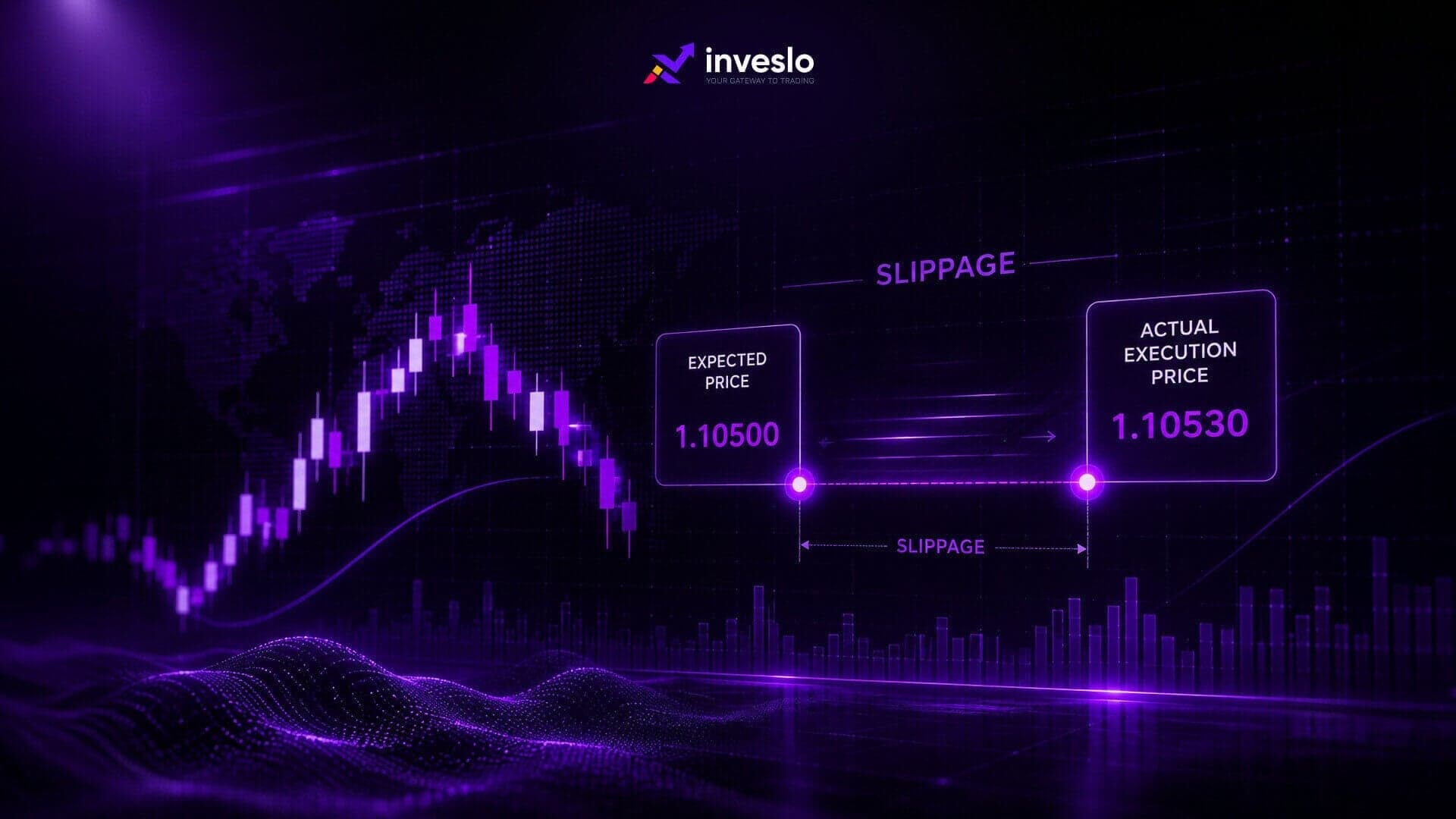
Slippage in Trading: What it is and How to Reduce it?
Slippage in trading costs most retail traders more than they realise, and it's rarely discussed until after the damage is done. You place an order at one price, it fills at another, and suddenly your trade is already underwater before the market's moved a tick against you. It happens fast.